


TLDR
- SIMD 547 would link Solana fee burns to compute usage rather than base transactions alone
- Supporters say higher network activity could raise daily SOL burns during busy market periods sharply
- Current estimates place possible daily burns near 10,800 to 64,800 SOL during heavy use cycles
- Anatoly’s stated support has drawn more attention to Solana’s changing fee policy debate this week
- SOL remains pressured near key support as traders watch whether demand can recover this week
Solana’s SIMD 547 proposal has drawn attention across the crypto market. The proposal would change how parts of network fees get burned. It would connect SOL burning more closely with real network use.
Supporters of the plan say the current system does not reflect total resource demand. They argue that compute usage should play a larger role. The debate comes as traders also watch weak short-term SOL price action.
SIMD 547 targets resource based fee burning
SIMD 547 would adjust Solana’s burn model by using actual computing resources. The current discussion centers on fees beyond only the base transaction fee. That approach would make burning more responsive during busy network periods.
According to estimates shared in market commentary, daily SOL burn could rise sharply. The stated range sits between 10,800 and 64,800 SOL during heavy activity. Current daily burn was described near 650 SOL in the same material.
The change would matter most when demand rises on the network. Higher activity would create more resource based fees. A larger share of those fees could then be removed from supply.

Solana co-founder Anatoly Yakovenko has reportedly shown support for the direction. However, the proposal still needs review through Solana’s governance process. Market users are watching whether developers support the final design.
Supply debate grows as Solana activity expands
The burn debate comes as Solana remains one of the most used blockchain networks. Network activity often rises during meme coin trading, NFT activity, and app launches. These periods can place more demand on Solana’s blockspace.
Supporters say a stronger burn model could balance new SOL issuance during busy cycles. Daily inflation was described near 60,000 SOL in the supplied market notes. Under high demand, proposed burns could cover a larger share of issuance.
The proposal also arrives during a busy week for Solana news. Colosseum’s Frontier Hackathon received 2,857 submissions from 108 countries. Other updates included Pump.fun’s multichain move and growing activity in trading card markets.
Market commentary also showed mixed views on Solana and rival layer one networks. Trader Gainzy222 said, “Solana is probably cooked,” while pointing to HYPE usage. That statement reflects one market view, not a confirmed network trend.
SOL price remains under pressure near support
SOL has traded with lower highs and lower lows since its mid-May peak. The price has been consolidating near the $81 to $83 area. Traders described that zone as an important short-term support level.
A daily close below $81 could increase pressure on SOL. The next levels named by traders sit near $80 and $78. A wider support zone was placed near $74 to $76.
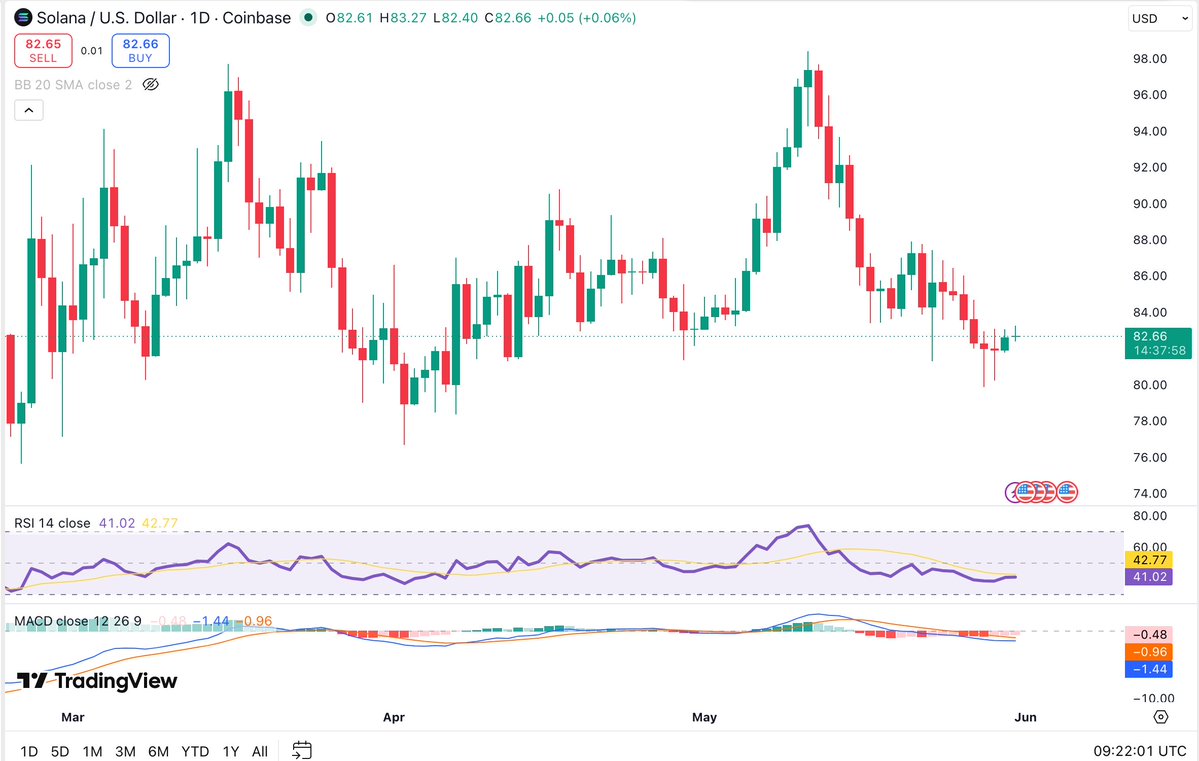
On the upside, SOL faces resistance near $84 dollars to $85 . A move above $86 dollars to $88 may show stronger recovery. A break above $92 would improve the current market structure.
Momentum readings remain weak, based on the supplied chart notes. The RSI was listed near 40.85, below the neutral 50 level. The MACD also remained bearish, though selling pressure appeared less intense.
Get 3 Free Stock Ebooks
Discover top-performing stocks in AI, Crypto, and Technology with expert analysis.
- Top 10 AI Stocks - Leading AI companies
- Top 10 Crypto Stocks - Blockchain leaders
- Top 10 Tech Stocks - Tech giants



