



Key Highlights
- Ripple’s XRP token fell to critical support at $1.2710 on May 28, marking its lowest level since February 2025.
- Technical analysis reveals a potential triple-bottom formation alongside a hammer candlestick pattern, both considered bullish reversal indicators.
- Spot XRP ETFs recorded $118 million in net inflows during May, significantly outpacing Bitcoin and Ethereum fund performance.
- Market analyst ChartNerd cautioned that failure to hold the $1.28–$1.24 zone could trigger a decline toward $1.00.
- Ripple’s RLUSD stablecoin now commands a $1.8 billion market capitalization, with trading activity increasing 61% month-over-month.
Ripple’s native token experienced significant downward pressure this week, reaching a pivotal support zone that has previously defended against further losses throughout 2025. The digital asset bottomed at $1.2710 on May 28, matching price levels that provided stability during February and on two occasions in April.
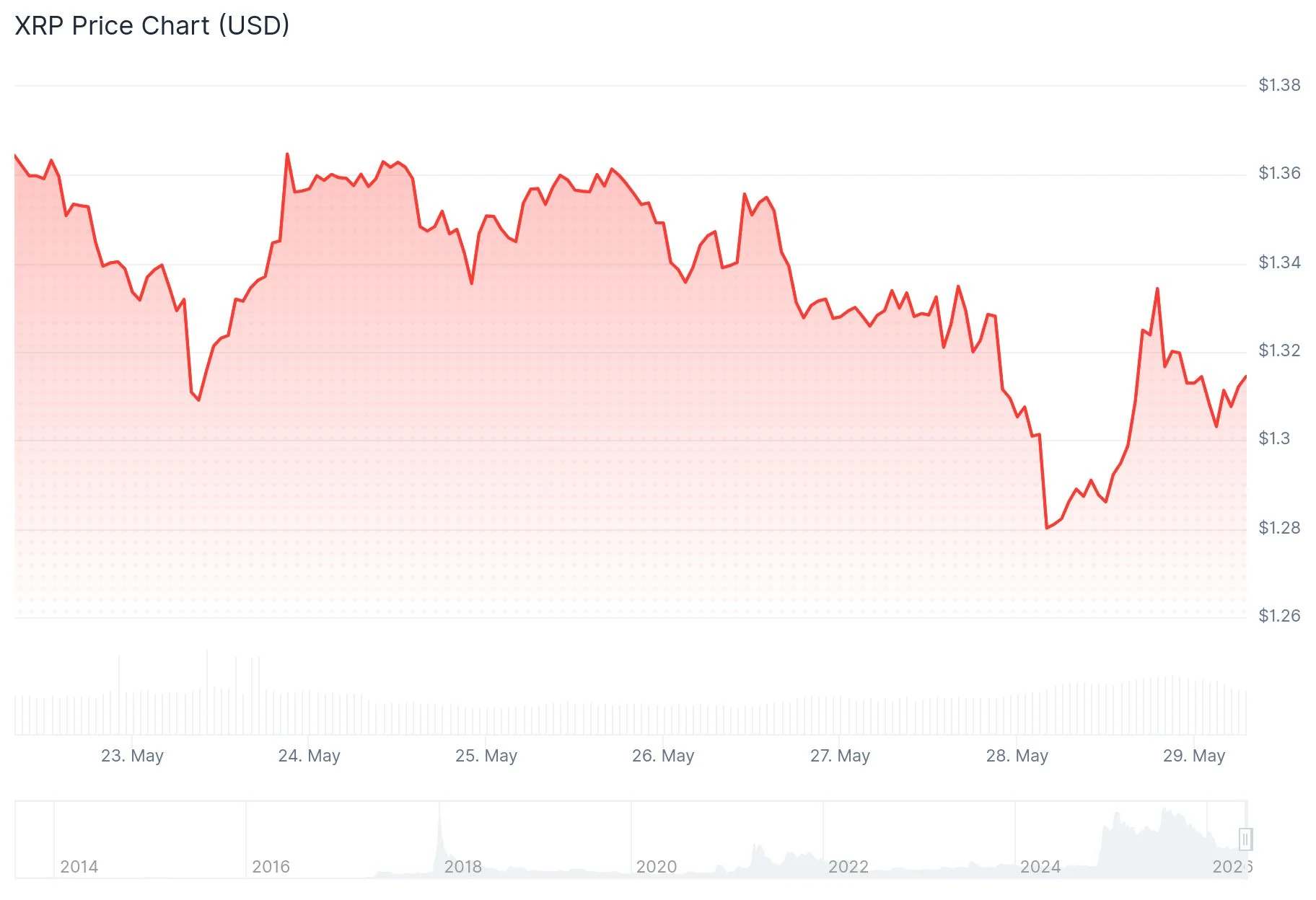
Following a peak of $1.5480 recorded on May 14, XRP has surrendered approximately 18% of its value over a two-week period. This downturn coincided with widespread cryptocurrency market weakness that impacted Bitcoin and numerous alternative digital assets.
Recovery efforts have since begun taking shape. On May 29, XRP managed to reclaim territory above $1.29 before encountering selling pressure near the $1.32 threshold. Current trading activity positions the token beneath its 100-hour simple moving average.
Technical Indicators Point to Potential Reversal
Market participants are closely monitoring the $1.2710 support threshold. Three distinct rebounds from this price floor throughout the current year have created what appears to be a triple-bottom configuration, a technical formation that analysts frequently interpret as evidence of diminishing bearish momentum.
Additionally, a hammer candlestick pattern is developing on the daily timeframe, characterized by a compact body and an extended lower wick. This chart formation commonly appears before short-term upward price movements.

Should XRP successfully defend the $1.2710 level, traders anticipate a potential rally toward $1.50, representing approximately 15% upside from present valuations. Critical overhead resistance zones include $1.3280, followed by $1.3420, and subsequently $1.3650.
Market analyst ChartNerd shared analysis on X: “$XRP has swept below the $1.30 guardrail and is now searching for the lowest daily candle close since early February. Current FIB support rests between $1.28/$1.24. It’s got to hold, or the $1 potential opens up sooner rather than later.” This assessment emphasizes the importance of maintaining current support levels.
A breakdown beneath $1.2720 would expose lower targets at $1.2550 and subsequently $1.2250. Further weakness could bring the year-to-date low of $1.1176 back into focus.
Strong ETF Demand and RLUSD Growth Continue
Despite recent price weakness, fundamental metrics paint a more optimistic picture. Spot XRP exchange-traded funds have attracted $118 million in net new capital throughout May, representing the strongest monthly performance in 2025 and ranking third-best since product launches.
Bitwise’s XRP ETF has independently secured more than $446 million in cumulative inflows and maintains $337 million in total assets under management. Recent data indicates ETF investors purchased $1.77 million worth of XRP during a single trading session, elevating combined ETF-held net assets to $1.12 billion.
This performance stands in stark contrast to spot Bitcoin ETFs, which experienced over $2 billion in net outflows during the same period, while Ethereum-focused products lost $401 million.
Ripple’s USD-pegged stablecoin (RLUSD) has maintained its expansion trajectory. The token now boasts a market capitalization of $1.8 billion, substantially higher than its initial $697 million valuation at launch. Adjusted trading volume reached $11.1 billion, representing a 61% increase compared to the previous month.
Trading activity concluded on May 29 with XRP hovering near $1.30, as market participants on both sides monitor the critical $1.2710 support zone for directional cues.
Get 3 Free Stock Ebooks
Discover top-performing stocks in AI, Crypto, and Technology with expert analysis.
- Top 10 AI Stocks - Leading AI companies
- Top 10 Crypto Stocks - Blockchain leaders
- Top 10 Tech Stocks - Tech giants



