



Key Takeaways
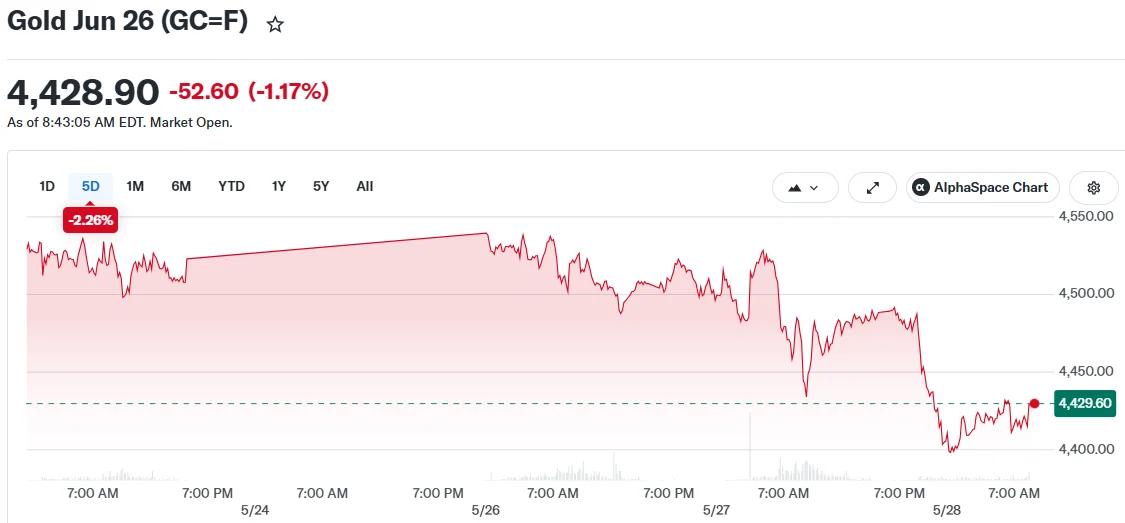
- Spot gold declined 1.4% to $4,392.88 per ounce, marking its lowest level in two months on Thursday.
- Iran’s Revolutionary Guard launched an attack on a U.S. military installation in Kuwait following earlier American strikes on Iranian territory.
- Oil markets saw renewed upward pressure, remaining beneath the $100 threshold but substantially elevated compared to pre-conflict levels.
- Escalating energy prices have reignited concerns that persistent inflation may compel central banks to implement tighter monetary policy.
- Markets await the U.S. April PCE inflation data on Thursday, with forecasts pointing to a headline rate increase to 3.8%.
Precious metals experienced significant downward pressure on Thursday, with gold reaching its weakest position in two months. The selloff intensified following renewed military exchanges between the United States and Iran, which propelled crude oil prices higher and refocused investor attention on inflationary pressures.
Spot gold retreated 1.4% to settle at $4,392.88 per ounce. Gold futures contracts declined 1.3% to $4,423.37 per ounce. This downturn pushed the yellow metal below the $4,400 to $4,600 trading corridor it had maintained throughout mid-May.
Middle East Conflict Intensifies With New Strikes
Iran’s Islamic Revolutionary Guard Corps announced on Thursday that it had targeted a U.S. military facility in Kuwait. The operation was characterized as retaliatory action following American military strikes on the Iranian coastal city of Bandar Abbas.
Kuwaiti authorities acknowledged that their air defense systems were deployed to counter incoming projectiles and unmanned aerial vehicles. Government representatives stopped short of publicly identifying the origin of the attacks.
This development represents yet another intensification in hostilities that have persisted for approximately three months. U.S. officials have consistently characterized their military operations as defensive measures while simultaneously asserting that a ceasefire arrangement remains operational.

In earlier statements on Thursday, President Donald Trump rejected intelligence suggesting that Iran would reopen the Strait of Hormuz to civilian maritime traffic within 30 days. He additionally expressed dissatisfaction with existing peace negotiation frameworks.
Energy Market Volatility Amplifies Inflation Anxiety
Oil prices advanced once more in response to the latest military confrontations. While crude has not breached the $100 per barrel mark, current valuations remain considerably higher than pre-conflict baselines.
Elevated energy costs typically transmit inflationary pressure throughout the broader economy. Should petroleum prices persist at heightened levels, monetary authorities may face mounting pressure to implement restrictive interest rate policies.
This scenario poses particular challenges for gold markets. As a non-yielding asset that generates neither interest income nor dividends, gold becomes comparatively less appealing when interest rate expectations trend upward or remain elevated.
“Rates markets are still displaying elevated central bank pricing,” analysts at ING said in a note.
The inverse correlation between gold valuations and interest rate expectations is well-established. When borrowing costs are anticipated to remain elevated for extended periods, investors typically rotate away from non-income-producing assets such as precious metals.
Critical Inflation Report Commands Market Attention
Traders and investors are focused on Thursday’s release of the U.S. personal consumption expenditures price index for April. This metric represents one of the Federal Reserve’s primary benchmarks for gauging inflationary trends.
Economists anticipate the headline PCE measure will have accelerated to 3.8% on a year-over-year basis in April, climbing from the 3.5% recorded in March. The month-over-month reading is projected to moderate slightly to 0.5% from the previous 0.7%.
The core PCE metric, which excludes volatile food and energy components, is forecast to register at 3.3% annually. The monthly core figure is expected to remain unchanged at 0.3%.
Federal Reserve policymakers have expressed divergent views in recent weeks regarding the appropriate monetary policy trajectory, with debate spanning potential rate increases, maintenance of current levels, or the initiation of rate reductions. The April PCE data release could prove decisive in shaping these internal deliberations.
Thursday’s gold selloff underscores the heightened market sensitivity to any indication that inflationary pressures remain stubbornly persistent and resistant to cooling.
Get 3 Free Stock Ebooks
Discover top-performing stocks in AI, Crypto, and Technology with expert analysis.
- Top 10 AI Stocks - Leading AI companies
- Top 10 Crypto Stocks - Blockchain leaders
- Top 10 Tech Stocks - Tech giants



