



TLDR
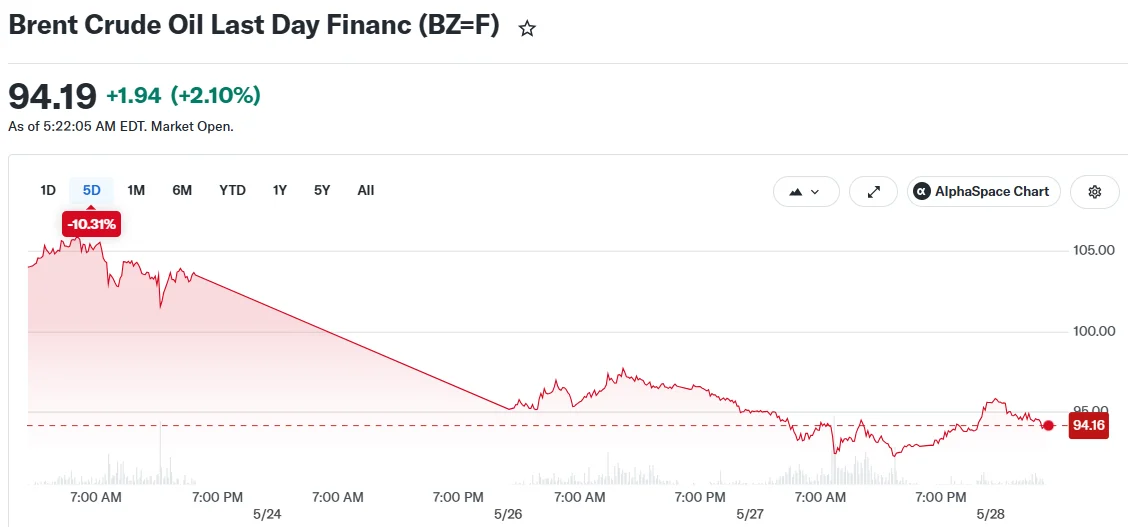
- Brent crude climbed over 2.5% to reach $96.74 per barrel, while WTI touched $90.95 following renewed military action
- Iran’s Revolutionary Guard launched strikes on a U.S. military installation in Kuwait; Kuwaiti authorities confirmed defending against aerial attacks
- President Trump rejected claims that Iran would reopen the Strait of Hormuz shipping lane within 30 days
- The strait’s ongoing blockade continues to affect approximately 20% of the world’s oil supply
- Market experts caution that oil markets are entering a critical phase with severe implications for supply chains
Crude oil futures experienced a significant rally on Thursday following a new round of military strikes exchanged between Washington and Tehran, intensifying concerns that diplomatic resolution remains distant.
Brent crude futures advanced more than 2.5% to reach $96.74 per barrel during early European market hours. Meanwhile, U.S. West Texas Intermediate contracts climbed to $90.95 per barrel.
The price surge followed an announcement from Iran’s Islamic Revolutionary Guard Corps claiming responsibility for strikes targeting a U.S. military facility in Kuwait. The operation was described as retaliation for American attacks on Iran’s port city of Bandar Abbas.
Kuwaiti officials acknowledged their defense forces were responding to incoming missile and drone threats, though they stopped short of identifying the attacking party.
This latest military exchange represents a resumption of direct confrontation between the two nations, contradicting Washington’s ongoing assertions that a ceasefire arrangement remained effective.

President Donald Trump previously shot down media reports suggesting Iran planned to restore commercial vessel traffic through the Strait of Hormuz within the next month.
The president further indicated his dissatisfaction with the current state of potential peace negotiations, suggesting diplomatic progress may be slower than market participants had anticipated.
Oil prices had actually retreated on Wednesday amid speculation that a U.S.-Iran agreement was imminent. Trump’s subsequent statements rapidly eroded that market sentiment.
Hormuz Blockage Keeping Supply Tight
The strategically vital Strait of Hormuz has remained effectively closed for three months due to the ongoing military conflict. This blockade is currently impacting roughly one-fifth of worldwide oil distribution.
While a limited number of vessels have successfully navigated the waterway in recent weeks, overall traffic volumes remain substantially depressed compared to pre-conflict levels.
Trump also dismissed a diplomatic proposal that would have placed the strait under joint Iranian-Omani administration, maintaining his position that no individual nation should exercise exclusive control over the strategic passage.
Market analysts from ANZ emphasized that oil supply continues to face significant constraints, while fundamental disagreements between Washington and Tehran remain unresolved.
Researchers at Yardeni Research issued warnings that the petroleum market is nearing a dangerous threshold. Their analysis suggests Iran confronts severe oil storage capacity limitations that may compel the nation to halt production operations completely.
They further highlighted that global oil distribution infrastructure is operating with minimal reserve capacity, potentially beginning to impact pipeline systems and related facilities.
Market participants are closely monitoring forthcoming U.S. Energy Information Administration inventory reports scheduled for Thursday release. Ongoing supply interruptions have already generated substantial drawdowns in stockpiled reserves.
Commodity market strategists indicate that volatility remains elevated across the energy sector as geopolitical uncertainty persists.
The standoff continues to evolve, with Washington and Tehran remaining fundamentally divided over Iran’s nuclear program and the question of maritime control over the strategic waterway.
Get 3 Free Stock Ebooks
Discover top-performing stocks in AI, Crypto, and Technology with expert analysis.
- Top 10 AI Stocks - Leading AI companies
- Top 10 Crypto Stocks - Blockchain leaders
- Top 10 Tech Stocks - Tech giants



