



Key Takeaways
- An institutional trader executed a massive $1.3B sale of BlackRock’s Bitcoin ETF (IBIT) through a dark pool—the largest transaction of its kind on record.
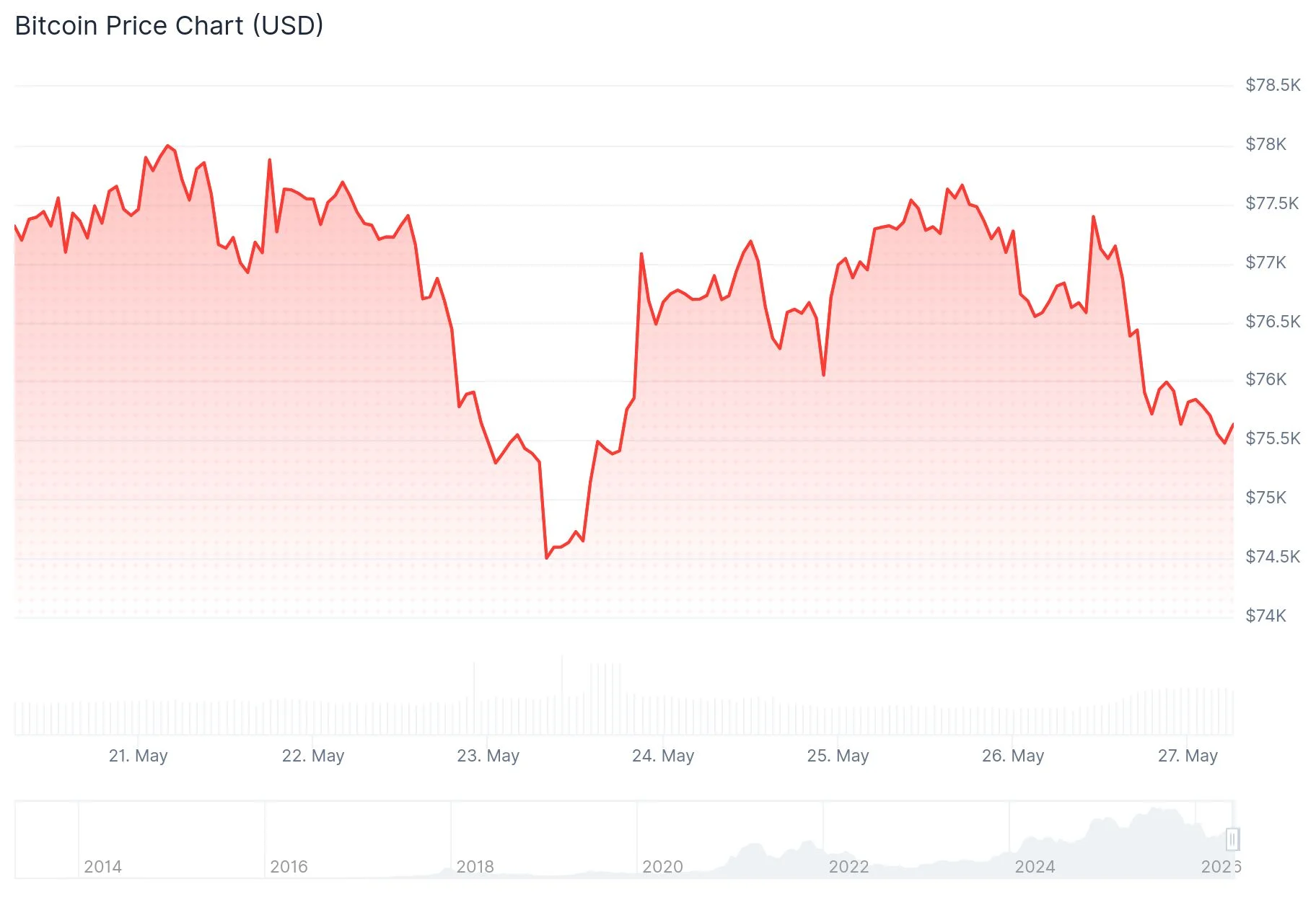
- Bitcoin declined 2.8% within 12 hours following the trade, reaching a 24-hour floor of $75,600.
- Geopolitical tensions escalated as US military operations against Iran heightened market anxiety, contributing to the third-largest weekly crypto fund outflow in 2026.
- Spot Bitcoin ETFs in the United States have experienced eight consecutive days of net withdrawals, exceeding $2 billion since May 14.
- Bitcoin must break through the $79,000 resistance level to restore bullish short-term momentum.
An institutional investor offloaded 29.2 million shares of BlackRock’s iShares Bitcoin Trust ETF (IBIT) at 2:30 pm UTC on Tuesday, May 27. This $1.3 billion transaction occurred via a dark pool—a private exchange platform where institutional players execute substantial orders without public market exposure.
The market reaction was swift and pronounced. According to TradingView analytics, Bitcoin experienced a 1.5% decline within ten minutes of the sale, sliding from $77,875 to $76,720. The cryptocurrency continued its downward trajectory, eventually touching a 24-hour low of $75,600 approximately 12 hours later—representing a cumulative daily drop of 2.8%.
Alex Thorn, Galaxy Digital’s head of firmwide research, confirmed this was the largest dark pool transaction involving a Bitcoin ETF that he has documented. Bloomberg’s ETF specialist Eric Balchunas emphasized the magnitude, noting the sale exceeded the second-largest IBIT sell order from that day by more than 22 times.
Crypto analyst Daan Crypto Trades shared on X: “Clean retest of the April 2025 lows with a decent bounce so far. But the level to break for continuation remains the low $80Ks. Below $74K I’d say bears are back in control.” His analysis highlights the critical price zones traders are monitoring in current market conditions.
Sustained ETF Capital Flight Continues
US-based spot Bitcoin ETFs have registered eight straight days of negative net flows. Tuesday’s session alone witnessed $333.6 million in withdrawals, with IBIT contributing $192.4 million to that total. Since May 14—the most recent day of positive inflows—cumulative outflows have surpassed $2 billion.

Institutional market participant Jane Street slashed its Bitcoin ETF exposure by approximately 70% during Q1. Similarly, Goldman Sachs trimmed its Bitcoin ETF holdings by 10% in the same timeframe. These strategic reductions signal a broader institutional retreat from Bitcoin investment vehicles.
The overall digital asset investment landscape mirrored this negative trend. According to CoinShares analytics, cryptocurrency investment products hemorrhaged $1.47 billion last week. Bitcoin-focused products represented $1.315 billion of those losses, while Ethereum funds shed an additional $223 million. This marked the third-largest weekly capital exodus in 2026.
Geopolitical Instability Compounds Market Anxiety
Rising international tensions added another layer of uncertainty to market sentiment. On Monday, the United States launched military strikes against targets in southern Iran, focusing on alleged missile launch facilities and maritime vessels suspected of deploying mines. US Central Command characterized the operation as a defensive measure.
Iran’s Islamic Revolutionary Guard Corps asserted it successfully downed a US drone operating within Iranian territorial airspace. Iranian state media additionally reported engagement with a fighter aircraft and a second drone. Diplomatic negotiations between the nations continue in Qatar, though no resolution has materialized.
Despite the volatile geopolitical environment, Bitcoin and Ethereum showed modest gains compared to Monday’s closing prices. At the time of publication, BTC was trading around $77,686 on the 4-hour timeframe, representing a 0.74% increase following its recovery from recent support levels.
The Relative Strength Index registered approximately 57.80, remaining below overbought conditions. The Chaikin Money Flow indicator climbed to 0.42, suggesting increased buying pressure during the recent rebound. Market analysts indicate that if BTC maintains support above $77,500 and successfully breaches the $79,000 resistance, a move toward $81,000 becomes increasingly viable. Conversely, a breakdown below $75,000 could expose the $73,500 level.
Get 3 Free Stock Ebooks
Discover top-performing stocks in AI, Crypto, and Technology with expert analysis.
- Top 10 AI Stocks - Leading AI companies
- Top 10 Crypto Stocks - Blockchain leaders
- Top 10 Tech Stocks - Tech giants



