


Key Highlights
- Shares of SK Hynix climbed nearly 7% during Tuesday’s trading session, contributing to South Korea’s KOSPI breaking above 8,000 for the first time ever.
- The rally followed Nvidia’s impressive Q1 results showing $81.6 billion in revenue, representing an 85% year-over-year increase.
- SK Hynix delivered Q1 operating profit of 37.61 trillion won, marking a staggering 405% increase compared to the previous year, with operating margins reaching 72%.
- Industry analyst TrendForce anticipates DRAM pricing will surge 58–63% while NAND flash prices could climb 70–75% during Q2 2026.
- The memory chip manufacturer unveiled its innovative “iHBM” thermal management technology, which reduces heat resistance by 30% for advanced AI processors.
Shares of SK Hynix experienced a dramatic surge of nearly 7% on Tuesday, propelling South Korea’s benchmark KOSPI index past the historic 8,000 threshold for the first time.
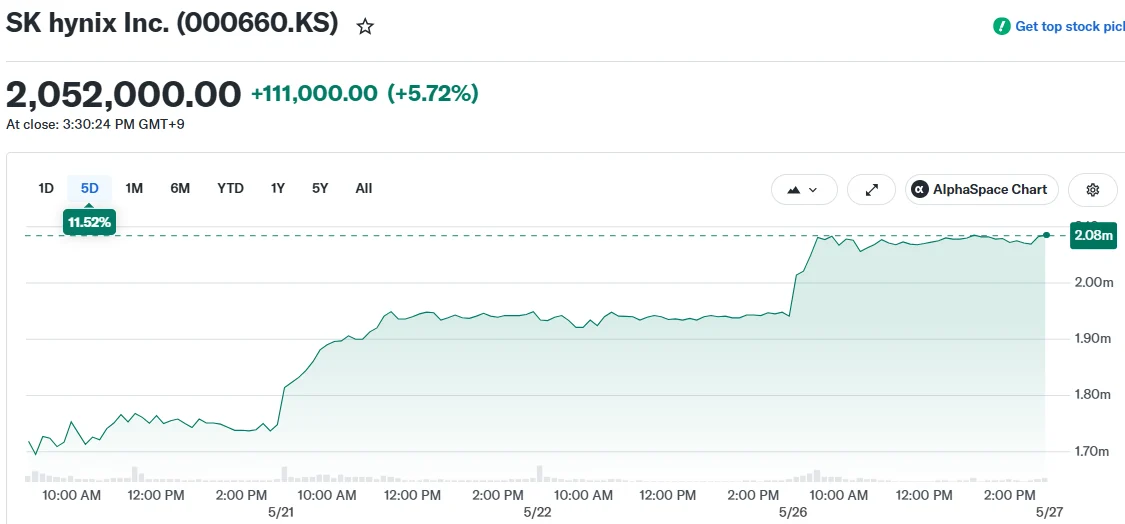
The stock maintained gains of approximately 5.72% during the latest trading period, as the entire market benefited from renewed enthusiasm surrounding AI-powered semiconductor growth.
The momentum began with Nvidia’s exceptional fiscal Q1 earnings announcement from last week. The graphics chip leader delivered revenue totaling $81.6 billion, representing an 85% year-over-year expansion, while its data centre segment surged 92% to reach $75.2 billion.
CEO Jensen Huang characterized the demand environment as having “gone parabolic.”
Those comments resonated powerfully with memory sector investors. As a key provider of high-bandwidth memory components for Nvidia’s AI accelerators, SK Hynix stands to benefit directly from this explosive growth trajectory.
According to the company, customer orders for HBM products spanning the next three years have already surpassed its available manufacturing capacity.

First Quarter Results Validate Bullish Sentiment
SK Hynix’s latest quarterly performance has been equally impressive. During Q1 2026, the memory manufacturer generated revenue of 52.58 trillion won alongside operating profit of 37.61 trillion won — representing a remarkable 405% year-over-year increase.
The company achieved a 72% operating margin, powered by robust demand for HBM chips, high-capacity server DRAM solutions, and enterprise-grade solid-state drives.
Wall Street analysts wasted no time revising their outlooks upward. UBS elevated its price target to 1.7 million won while boosting 2026 and 2027 earnings estimates by 22% and 29% respectively. Mirae Asset Securities set an ambitious target of 3.2 million won, with SK Securities proposing a bull scenario reaching 3 million won.
TrendForce contributed additional momentum to the narrative, forecasting conventional DRAM contract pricing will increase 58–63% on a quarter-over-quarter basis in Q2 2026. NAND flash memory prices face similar pressure, with anticipated gains of 70–75% during the identical timeframe.
These aren’t speculative estimates — they indicate a memory marketplace experiencing authentic supply constraints across numerous product segments.
Company Unveils iHBM Thermal Innovation
Beyond impressive financial metrics, SK Hynix introduced a groundbreaking product on Tuesday: the iHBM solution, representing an advanced thermal management breakthrough engineered for future HBM chip generations including HBM5.
This technology integrates cooling components directly into the Die-to-Die Physical Layer — the critical interface connecting HBM and GPU — where thermal buildup reaches its peak. The innovation delivers a 30% decrease in thermal resistance.
The solution leverages SK Hynix’s proven MR-MUF packaging architecture, enabling clients to implement it without extensive redesign efforts.
The company positioned this advancement as a strategic answer to thermal management obstacles accompanying higher die stacking configurations at increased speeds required for AI data processing workloads.
Kangwook Lee, Senior VP and Head of PKG Development, noted the iHBM solution “combines memory design capabilities with advanced packaging technology” to meet demands within high-density AI computing environments.
The KOSPI index, which has climbed approximately 75% year-to-date in 2026, represents one of the globe’s most concentrated public equity exposures to AI infrastructure growth. Samsung Electronics and SK Hynix collectively comprised 44% of the index’s total market capitalization when it surpassed 7,000 earlier this month.
Get 3 Free Stock Ebooks
Discover top-performing stocks in AI, Crypto, and Technology with expert analysis.
- Top 10 AI Stocks - Leading AI companies
- Top 10 Crypto Stocks - Blockchain leaders
- Top 10 Tech Stocks - Tech giants



