


TLDR
- Gold declined approximately 1% to roughly $4,529 following additional U.S. military operations against Iran
- Both the dollar and crude oil prices rallied on news of the military action, weighing on precious metals
- Platinum and silver also retreated, with silver declining more than 2%
- Traders now assign a 40% probability to a 25-basis-point Fed rate increase before year-end
- Secretary of State Marco Rubio indicated a U.S.-Iran agreement would require “a few days,” tempering optimism for imminent peace
Bullion prices retreated on Tuesday after additional U.S. military operations against Iran interrupted a recent upward trend, as the greenback stabilized and crude oil reversed course.
Spot gold declined 0.9% to $4,529.07 per ounce during Asian market hours. Gold futures remained comparatively stable at $4,560.92. Earlier in the session, New York gold futures had momentarily advanced 0.2% to $4,532.30 before reversing.
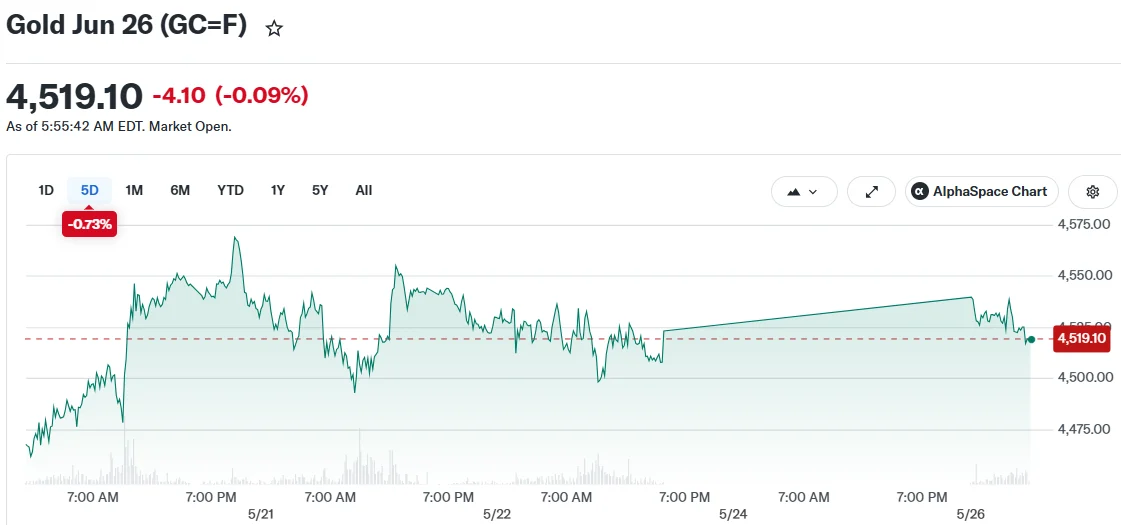
Additional precious metals mirrored gold’s downward movement. Spot silver tumbled 2.1% to $76.43 per ounce. Spot platinum declined 0.7% to $1,951.33.
The downturn followed U.S. military operations targeting missile launch facilities and mine-deploying vessels in southern Iran late Monday. U.S. Central Command characterized the operations as “self-defence.”
Gold and related metals had accumulated gains in previous sessions. Speculation had suggested Washington and Tehran were approaching a preliminary agreement to reopen the Strait of Hormuz. Monday’s military action extinguished that optimism.

Peace Deal Doubts Grow
Iranian officials cautioned that additional strikes against the nation’s military infrastructure would trigger retaliation. The warning escalated tensions between the two nations following what had been tentative diplomatic advances.
Secretary of State Marco Rubio contributed to market uncertainty. He stated an agreement would require “a few days” and emphasized the Strait of Hormuz would reopen “one way or another.” Central Command simultaneously confirmed the current ceasefire technically remained active.
These contradictory messages left market participants struggling to interpret the situation. The likelihood of an imminent peace settlement diminished rapidly.
The dollar stabilized after declining in recent trading sessions. A firmer dollar generally pressures gold, as the commodity is denominated in U.S. currency.
Crude oil prices recovered following a week of losses, reacting to news of the military strikes. Elevated oil prices heighten inflation anxieties, and such concerns typically encourage central banks toward restrictive monetary measures.
Rate Hike Fears Weigh on Gold
This environment presents challenges for gold. Although gold traditionally functions as an inflation safeguard, elevated interest rates amplify the opportunity cost of holding gold, as the metal generates no income.
Markets currently assign a 40% probability the Federal Reserve will implement a 25-basis-point rate increase before year-end. This represents a meaningful adjustment. Markets had previously fully priced in a quarter-point Fed rate hike by December.
Additional major central banks have similarly indicated potential rate increases to combat energy-related inflation connected to the Iran situation.
Gold has encountered headwinds throughout this year from concerns that the Iran conflict would sustain elevated energy prices and compel central banks toward more hawkish rate policies.
The most recent military strikes have not alleviated those concerns. With the peace agreement timeline now uncertain, the inflationary impact from oil remains an active concern for bullion market participants.
Get 3 Free Stock Ebooks
Discover top-performing stocks in AI, Crypto, and Technology with expert analysis.
- Top 10 AI Stocks - Leading AI companies
- Top 10 Crypto Stocks - Blockchain leaders
- Top 10 Tech Stocks - Tech giants



