


Key Highlights
- Japanese memory chipmaker Kioxia is working toward listing American depositary shares on a major U.S. exchange, leaving OTC trading behind
- The KXIAY ADR has skyrocketed 460% in 2026, significantly outperforming Micron’s 167% rise during the same timeframe
- Annual revenue jumped 37% to ¥2.34 trillion, while earnings per share nearly doubled compared to the previous fiscal year
- Dell and Kioxia unveiled a 2U server design capable of housing up to 9.8 petabytes of flash storage for AI applications
- Development is underway for GPU-adjacent SSDs in collaboration with Nvidia, potentially serving as an alternative to high-bandwidth memory
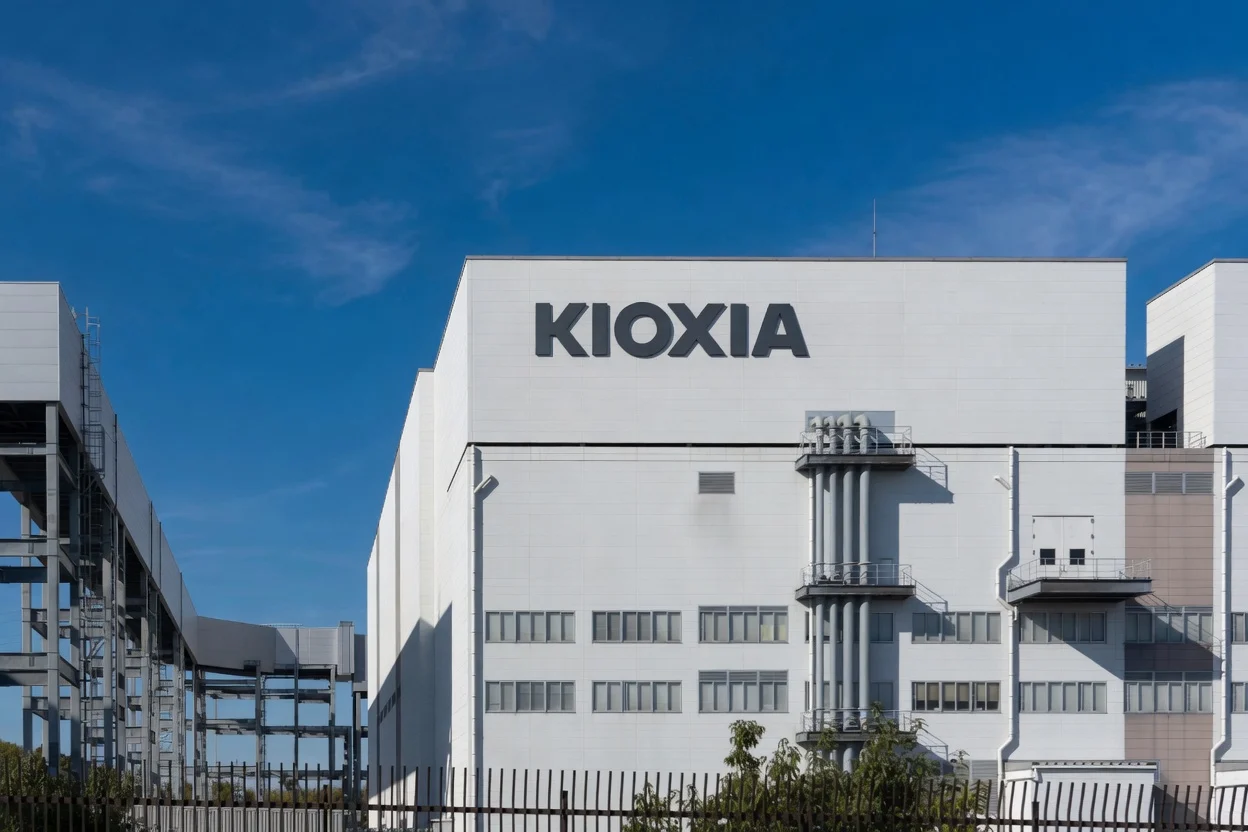
Kioxia Holdings (KXIAY) has announced plans to pursue a listing on a U.S. stock exchange, marking a significant step for the company as it seeks to broaden its appeal to American investors beyond over-the-counter trading.
The Tokyo-based flash memory manufacturer confirmed the move but emphasized that approval from regulators is still required. Specifics regarding the timeline, exchange selection, and listing structure remain undetermined.
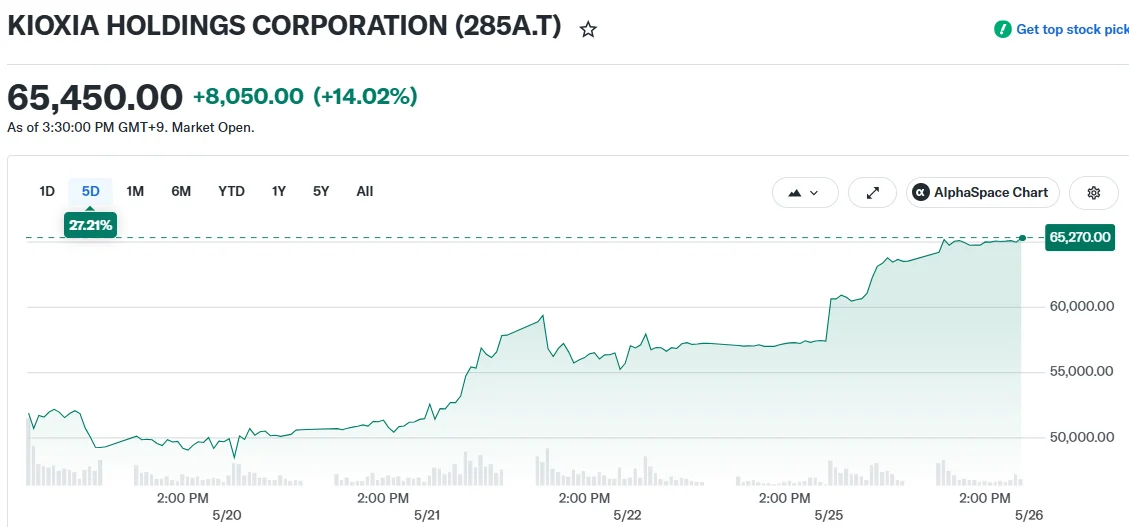
Shares of the over-the-counter KXIAY ADR have exploded 460% year-to-date. By comparison, Micron (MU), a leading U.S. competitor in the memory space, has gained approximately 167% during the same period.
For the fiscal year ending March 31, 2026, Kioxia disclosed impressive financial results. Revenue surged 37% year-over-year to ¥2.34 trillion. The company posted net income of ¥554.49 billion, with basic earnings per share nearly doubling from the previous year.
Profitability metrics showed substantial improvement. Operating margin widened to 37.2% from 26.5% in the prior year. Return on equity climbed to 51.9% from 45.9%, and return on assets jumped from 12.8% to 23.7%.

Operating cash flow reached ¥616.54 billion, up from ¥476.41 billion. The company ended the fiscal year with ¥470.71 billion in cash, comfortably exceeding short-term debt of ¥203.37 billion.
Innovation in AI-Focused Storage
Kioxia is advancing several cutting-edge products designed for next-generation computing. The company is engineering a Super High IOPS SSD designed to deliver more than 10 million input and output operations per second, with sample units expected in the latter half of 2026.
The CM9 series is also in development—a high-performance SSD tailored for AI systems that demand exceptional speed and durability.
Through its collaboration with Nvidia, Kioxia is creating GPU-adjacent SSDs capable of direct GPU connection. These drives could serve as a partial substitute for high-bandwidth memory in servers powering generative AI workloads.
Production of the company’s 10th-generation BiCS FLASH technology, featuring more than 300 layers, is scheduled to begin in 2026.
High-Density Storage with Dell
Dell and Kioxia recently introduced a 2U server platform capable of delivering up to 9.8 petabytes of flash storage, designed specifically for AI-driven and data-intensive enterprise environments. Leveraging PCIe 5.0 flash technology, the system is marketed as a high-density, power-efficient solution for modern AI infrastructure needs.
The collaboration was unveiled in conjunction with Dell’s launch of its Deskside Agentic AI offering, part of the broader AI Factory with Nvidia program.
Cosmo Securities analyst Kazuyoshi Saito highlighted that Kioxia’s NAND manufacturing costs are 20%-30% below those of competitors. The company also achieves superior storage density per unit area and delivers read/write speeds that are 10%-20% faster than rival products.
Kioxia operates major NAND fabrication facilities in Yokkaichi and Kitakami through a joint venture with SanDisk, splitting equipment investments and research and development expenses.
In a strategic move to reduce reliance on third-party DRAM suppliers, Kioxia recently agreed to purchase newly issued shares from Nanya, paired with a long-term DRAM supply contract.
One potential challenge on the horizon: competitors such as SK Hynix are rapidly advancing quad-level cell enterprise drives aimed at AI data centers. Kioxia has stated it is not currently pursuing high-bandwidth flash technology, which could result in missed opportunities in a rapidly expanding enterprise market segment.
Following the earnings announcement, the stock climbed 29.1% on the Tokyo Stock Exchange, where it is listed under the ticker TSE:285A.
Get 3 Free Stock Ebooks
Discover top-performing stocks in AI, Crypto, and Technology with expert analysis.
- Top 10 AI Stocks - Leading AI companies
- Top 10 Crypto Stocks - Blockchain leaders
- Top 10 Tech Stocks - Tech giants



