



Key Takeaways
- An attacker leveraged the Butter Network bridge vulnerability to create 1 quadrillion MAPO tokens out of thin air
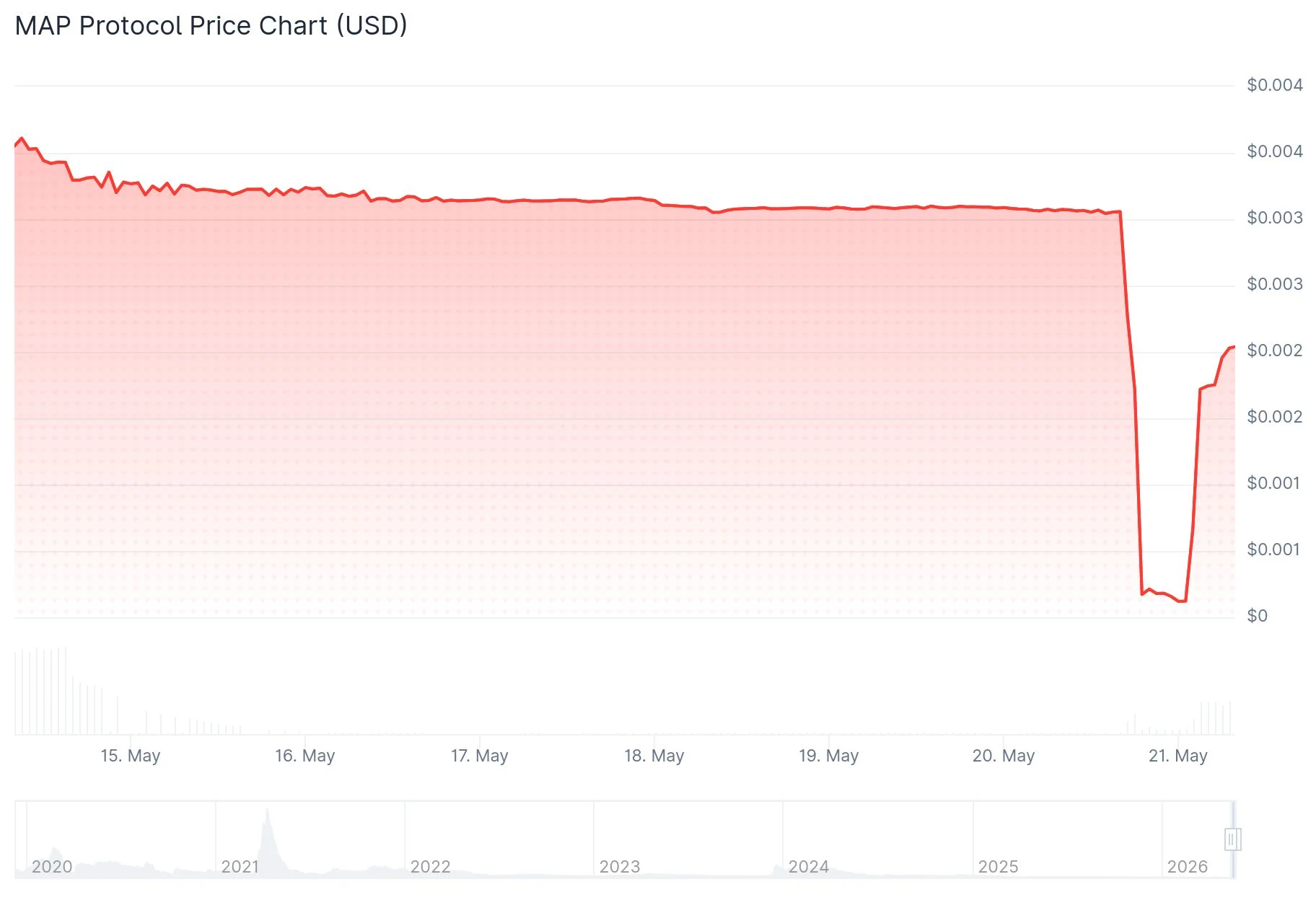
- The token’s value collapsed 96%, plummeting from $0.003 to $0.0001 in mere hours
- Approximately 1 billion tokens were liquidated, extracting roughly 52 ETH (~$180,000) from Uniswap liquidity sources
- Map Protocol suspended its mainnet operations and initiated contract migration procedures
- Another bridge exploit targeting TON-TAC resulted in $2.68 million losses on May 11, highlighting ongoing bridge security concerns
On Wednesday, a malicious actor successfully compromised the Butter Network cross-chain bridge infrastructure, fabricating one quadrillion MAPO tokens — approximately 100,000 times greater than the token’s authorized circulating supply. The devastating security breach triggered a 96% price collapse within hours.
MAP Protocol’s native cryptocurrency experienced a dramatic plunge from approximately $0.003 to $0.0001. The project’s market capitalization tumbled beneath the $1 million threshold, essentially erasing virtually all investor equity.
The perpetrator deployed a fresh externally-owned account to execute the sophisticated attack. Their methodology involved initially transmitting an authentic oracle-signed transaction, subsequently resubmitting an altered variant that maintained an identical hash signature while containing fraudulent data. The bridge’s validation mechanisms accepted it as legitimate and processed the enormous token generation.
The breach didn’t involve compromised private keys. Blockchain security specialist Blockaid identified the vulnerability as a standard Solidity coding flaw related to handling multiple dynamic parameters.
The malicious actor liquidated approximately one billion of the fabricated tokens through Uniswap liquidity pools, extracting about 52 ETH valued at roughly $180,000. The remaining supply — nearly a trillion tokens — remains in attacker-controlled addresses and poses an ongoing threat to additional liquidity sources.

Map Protocol’s Emergency Response
Map Protocol identified the vulnerability within the Solidity contract infrastructure. The development team immediately suspended mainnet operations and initiated migration procedures to a new contract architecture.
The project announced plans to reveal a new contract address and execute a comprehensive asset snapshot. All tokens residing in attacker-controlled wallets will be permanently invalidated and omitted from the snapshot calculations.
The Butter Network simultaneously suspended its ButterSwap service. Representatives emphasized that user deposits remained secure throughout the incident.
Escalating Bridge Security Crisis
This incident represents part of a disturbing pattern. At least 18 decentralized finance and blockchain platforms experienced security breaches this month, including THORChain, Verus Protocol’s Ethereum bridge, Transit Finance, and Ekubo.
The TON-TAC bridge suffered a separate attack on May 11. That compromise generated $2.68 million in damages and originated from inadequate validation protocols in the sequencer infrastructure. Approximately 80% of compromised assets were ultimately recovered, though the bridge continues to remain offline.
Cross-chain bridges must authenticate transactions spanning multiple blockchain networks, creating substantial vulnerability exposure. Ethereum co-founder Vitalik Buterin identified this fundamental weakness in 2022, maintaining that bridges are inherently less secure than the individual blockchains they interconnect.
Map Protocol functions as an omnichain infrastructure layer bridging Bitcoin, Ethereum, BNB Chain, Tron, and Solana — meaning its bridge architecture incorporates additional complexity and risk exposure.
For MAPO token holders, recovery prospects appear bleak. Even assuming successful migration execution, the existence of trillions of fraudulent tokens establishes a significant barrier to meaningful price recovery.
The attacker successfully extracted approximately $180,000 — a relatively modest financial gain for an operation that effectively annihilated a token’s market valuation and revealed critical bridge security deficiencies.
Get 3 Free Stock Ebooks
Discover top-performing stocks in AI, Crypto, and Technology with expert analysis.
- Top 10 AI Stocks - Leading AI companies
- Top 10 Crypto Stocks - Blockchain leaders
- Top 10 Tech Stocks - Tech giants



