



TLDR
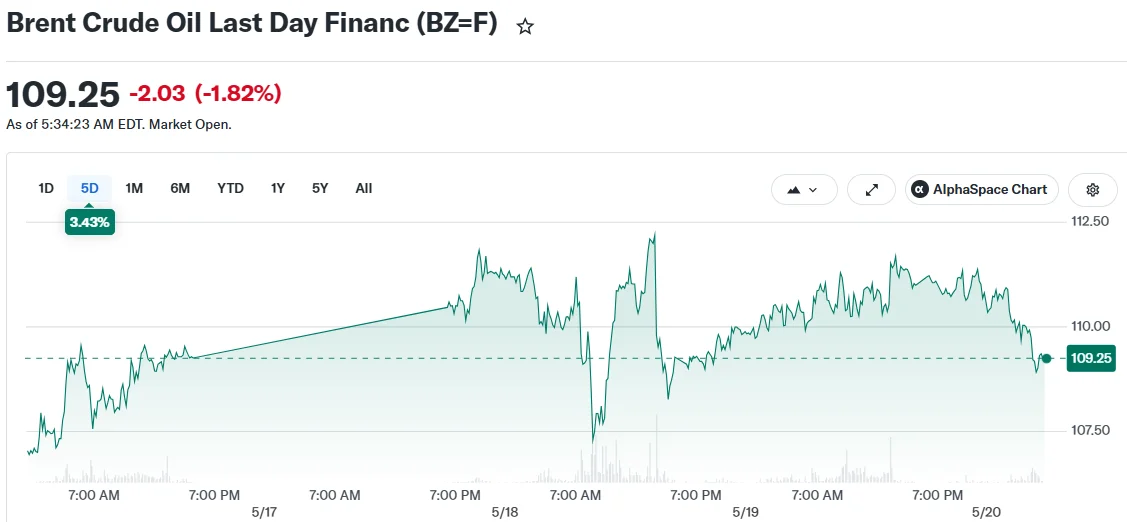
- Crude markets declined approximately 1–2.5% Wednesday following Trump’s comments that the Iran conflict could conclude “very quickly”
- Brent futures retreated to roughly $109 while WTI slipped toward $102 per barrel
- Two Chinese supertankers departed the Strait of Hormuz, signaling potential easing of transit constraints
- American crude stockpiles decreased for the fifth consecutive week, showing an unexpected 9.1 million barrel decline
- Citi strategists project Brent will climb to $120 per barrel shortly, arguing markets are misjudging supply vulnerability
Crude markets retreated by approximately 1–2.5% Wednesday as investors responded to encouraging developments in U.S.-Iran diplomatic negotiations. While traders are monitoring the situation carefully, energy analysts emphasize that supply vulnerabilities persist despite growing diplomatic optimism.
Brent crude contracts declined to approximately $109 per barrel while U.S. West Texas Intermediate retreated toward $102. Both benchmarks had similarly weakened roughly 1% during the previous session after Vice President JD Vance indicated discussions were making headway.
President Donald Trump informed congressional leaders Tuesday night that the Iran conflict could conclude “very quickly.” He had previously confirmed postponing a scheduled U.S. military strike against Iran and indicated that negotiations with Tehran were progressing favorably.
Iran’s most recent peace framework demanded cessation of all military operations, complete withdrawal of American military forces from the Middle East, and financial compensation for war damages. Washington broadly dismissed previous Iranian proposals, insisting that dismantling Iran’s nuclear capabilities remains a fundamental requirement for any agreement.
Tankers Moving Again Through the Strait of Hormuz
Two Chinese-registered supertankers transporting crude departed the Strait of Hormuz Wednesday. A South Korean-flagged vessel was similarly navigating outward after remaining stationary for over two months while carrying 6 million barrels of Middle Eastern petroleum.

The critical waterway has been essentially blocked to tanker operations since the U.S.-Israeli military campaign against Iran commenced in late February. The volume of vessels traversing the strait continues significantly below the approximately 130 that passed daily prior to hostilities.
Notwithstanding the tanker activity, LSEG analysts warned that supply flows will probably not normalize to pre-conflict volumes rapidly, even with a peace agreement in place.
Citi indicated Tuesday it anticipates Brent crude ascending to $120 per barrel in the immediate future. The financial institution argued oil markets are significantly underestimating the probability of an extended supply disruption.
U.S. Inventories Drop Sharply
American crude reserves have contracted for five consecutive weeks. Figures from the American Petroleum Institute revealed a 9.1 million barrel withdrawal last week, substantially exceeding the 3.4 million barrel reduction analysts had projected.
Official U.S. stockpile figures from the Energy Information Administration were scheduled for release later Wednesday and were anticipated to reflect a comparable pattern.
Trump has authorized the distribution of 172 million barrels from the Strategic Petroleum Reserve to mitigate supply disruptions stemming from the confrontation.
PVM analysts cautioned that worldwide petroleum inventories could decline to dangerously depleted thresholds. They observed that market participants have demonstrated surprising composure considering the magnitude of the supply interruption.
The premium on Brent futures for immediate delivery versus six-month contracts stands at approximately $21 per barrel — substantially beneath last month’s peak exceeding $35.
In a separate indication of tightening availability, Britain relaxed sanctions to permit imports of diesel and aviation fuel processed from Russian crude.
Markets are incorporating some diplomatic advancement, but analysts persist in cautioning that supply interruptions could intensify before any settlement materializes.
Get 3 Free Stock Ebooks
Discover top-performing stocks in AI, Crypto, and Technology with expert analysis.
- Top 10 AI Stocks - Leading AI companies
- Top 10 Crypto Stocks - Blockchain leaders
- Top 10 Tech Stocks - Tech giants



