


Key Takeaways
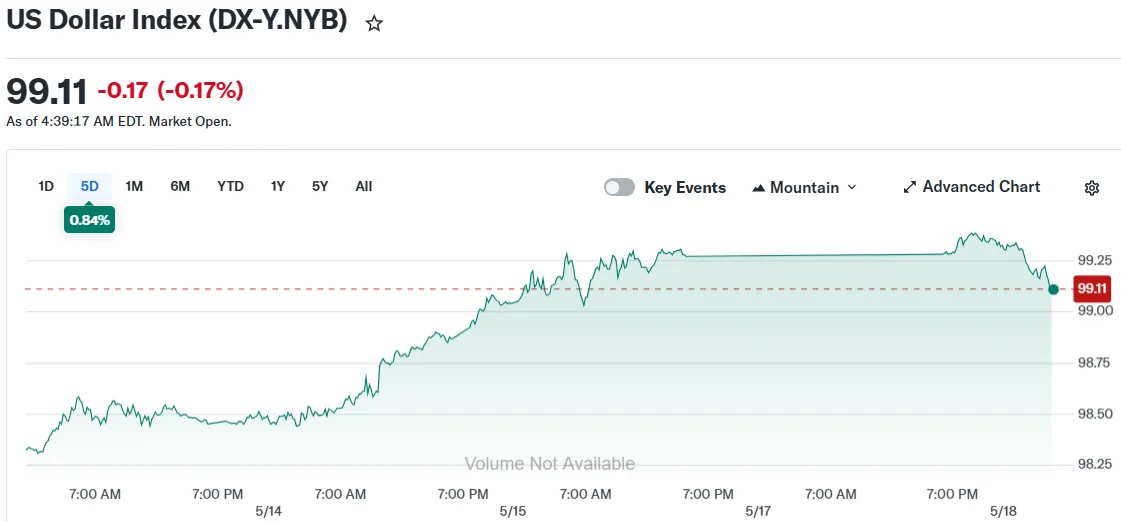
- The dollar index slipped only 0.1% after reaching its highest point in nearly six weeks, retaining the bulk of previous week’s advances
- Escalating confrontation between Washington and Tehran continues as Trump issues ultimatum on peace negotiations
- Traders now see 70% probability of Federal Reserve rate increase by year-end, with full hike anticipated by March 2027
- Crude prices surged 2% following drone strike on UAE nuclear facility attributed to Iran
- Weaker-than-forecast Chinese economic indicators for April weighed on Asian currency performance
The U.S. currency retreated modestly on Monday while maintaining proximity to its most robust position in more than five weeks. Ongoing anxieties surrounding Middle Eastern hostilities and climbing rate expectations kept the dollar well-supported.
The dollar index declined 0.1% to settle at 99.194 following an overnight peak of 99.409, representing a near six-week summit. This movement followed a robust trading week that delivered gains exceeding 1% for the benchmark.
Middle East Standoff Fuels Market Anxiety
The confrontation between the United States and Iran demonstrated no indication of de-escalation. President Trump cautioned Tehran that time was running short and hinted that military action remained a possibility should diplomatic efforts fail.
Additional intelligence suggested Washington and Jerusalem were coordinating potential military responses targeting Iranian interests. The volatile circumstances maintained elevated energy prices and applied downward pressure on fixed-income securities.
Crude oil prices jumped 2% at the start of the week after an unmanned aerial vehicle struck a nuclear power facility in the United Arab Emirates. UAE officials attributed responsibility to Iran, characterizing the incident as a “dangerous escalation.”

Rising oil prices amplified concerns regarding renewed inflationary pressures. This dynamic prompted markets to reassess interest rate trajectories globally, driving sovereign bond yields to levels unseen in years.
U.S. Treasury yields on 10-year notes climbed to nearly a one-year peak during the previous week. Meanwhile, 30-year bond yields ascended to their loftiest levels since approximately the 2008 financial crisis.
Market participants currently assign a 70% likelihood that the Federal Reserve will implement a rate increase before December concludes. Complete pricing for a full rate hike extends to March 2027, based on LSEG analytical data. The previous week’s inflation readings, which exceeded economist forecasts, intensified these monetary policy expectations.
Asian Currency Markets Face Headwinds
The Japanese yen traded without significant movement versus the dollar. Japanese government bond yields on 10-year securities rocketed to a 29-year zenith, while accelerating inflation has market observers anticipating a Bank of Japan policy adjustment in June.
Market strategists indicated that even a BOJ rate move would probably provide only marginal yen support given the prevailing dollar momentum across global markets.
The Chinese yuan depreciated following a series of lackluster economic releases. Industrial output expansion in China during April underperformed analyst projections. Consumer spending growth decelerated to its slowest pace in over three years.
Capital expenditure contracted for the first instance in a three-month span. The aggregate data signaled persistent fragility in consumer demand despite modest recovery momentum observed earlier in 2025.
Beijing and Washington reached a preliminary accord over the weekend to reduce certain trade levies following bilateral discussions. Nevertheless, specific implementation details of the arrangement remained ambiguous.
The Australian dollar depreciated 0.3% relative to the greenback, participating in a widespread decline throughout Asian currency markets.
The Iranian crisis is projected to continue exerting pressure on Asia’s largest economies through elevated energy expenses and commercial disruptions.
The dollar appears positioned to maintain its strength provided rate hike expectations persist and geopolitical uncertainties remain unresolved.
Get 3 Free Stock Ebooks
Discover top-performing stocks in AI, Crypto, and Technology with expert analysis.
- Top 10 AI Stocks - Leading AI companies
- Top 10 Crypto Stocks - Blockchain leaders
- Top 10 Tech Stocks - Tech giants



