


Key Takeaways
- U.S. 10-year Treasury yields climbed to approximately 4.54%, approaching annual peaks amid escalating crude oil prices.
- Brent crude futures surged beyond $108 per barrel, targeting a 6.7% weekly advance as Middle Eastern geopolitical tensions continue.
- International equity markets tumbled, with Europe’s STOXX 600 declining 1.37% and Asia-Pacific indices shedding over 2.5%.
- Market participants now assign approximately 50% probability to U.S. rates finishing the year above current levels, compared to just 14% seven days earlier.
- The greenback recorded its most substantial weekly advance in eight weeks, while the British pound tumbled to a five-week nadir during UK political turbulence.
International equity markets retreated on Friday as accelerating oil prices reignited inflation anxieties, driving bond yields upward and forcing a reassessment of interest rate trajectories. Market participants who had eagerly accumulated stocks throughout the week — including a 4% rally in Nvidia — pivoted their attention toward macroeconomic headwinds.
Europe’s STOXX 600 benchmark declined 1.37%. MSCI’s Asia-Pacific gauge excluding Japan tumbled 2.54%, while Japan’s Nikkei shed nearly 2% following reports showing the nation’s wholesale inflation reached 4.9% in April — the swiftest tempo in three years.
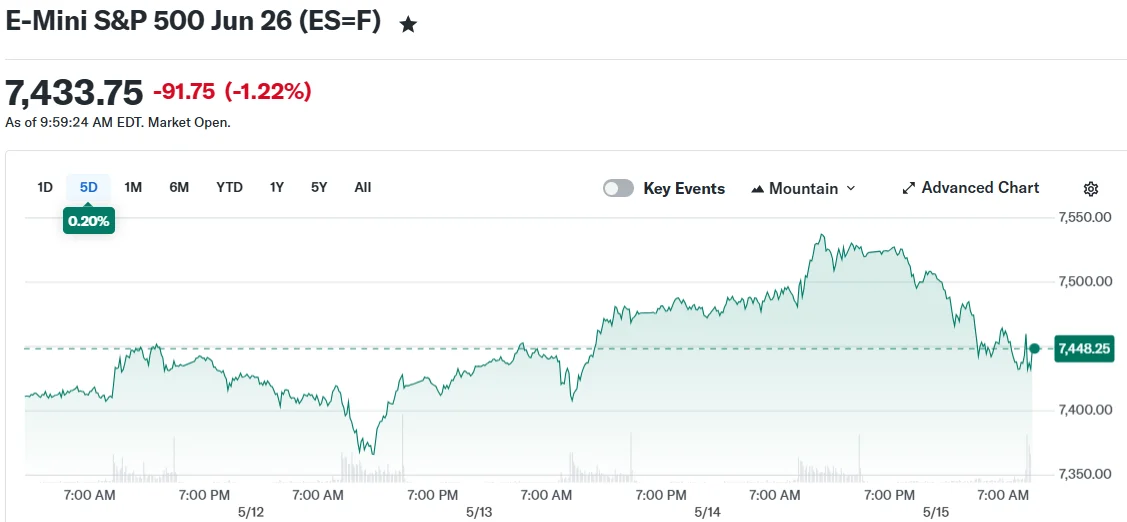
Across the Atlantic, Nasdaq futures declined 1.32% while S&P 500 futures retreated approximately 0.9%.
Treasury Yields Advance on Inflation Anxieties
Driving the market volatility is an acceleration in oil prices connected to the continuing conflict in Iran, which commenced in late February. Brent crude futures escalated above $108 per barrel on Friday, positioning the energy commodity for a 6.7% weekly appreciation.
The benchmark 10-year U.S. Treasury yield exceeded 4.54%, nearing its peak level since May of the previous year. The two-year note similarly advanced, climbing to approximately 4.05%.

The Bank of Japan disclosed that producer prices increased 4.9% on an annual basis in April, propelled predominantly by oil and petroleum-related products. Japanese government bond yields reached record territory during the trading session.
German 10-year bond yields — serving as the eurozone’s reference point — increased more than 7 basis points to roughly 3.12%.
Market Participants Recalibrate Rate Forecasts
The movement in crude prices has immediately influenced how market participants envision monetary policy evolution through year-end. Based on CME Group analytics, investors currently estimate roughly 50% odds that U.S. interest rates will conclude the year elevated above present levels. Merely seven days prior, that probability registered at approximately 14%.
Strategists at ING emphasized that the fundamental challenge stems from inflation already embedded within the economic system. The institution anticipates bond yields will face upward pressure in coming weeks.
“I think if anything is enough to create a pullback, it is what’s happening in rate markets,” said Tim Graf of State Street Markets.
President Trump wrapped up a state visit to Beijing on Friday. Following discussions with Chinese President Xi Jinping, Trump indicated both nations desire the Iran conflict’s conclusion and concur that Iran must be prevented from acquiring nuclear weapons capability. Nevertheless, the diplomatic engagement produced no tangible measures toward resolving the hostilities.
The dollar appreciated for a fourth consecutive session, targeting a 1.4% weekly climb — its strongest performance in eight weeks. The yen depreciated beyond 158 per dollar. Sterling slumped to a five-week minimum at $1.3360, following UK health minister Wes Streeting’s resignation, intensifying the nation’s political instability.
UK gilt yields similarly climbed as market participants contemplated the possibility of a leadership contest targeting Prime Minister Keir Starmer.
Get 3 Free Stock Ebooks
Discover top-performing stocks in AI, Crypto, and Technology with expert analysis.
- Top 10 AI Stocks - Leading AI companies
- Top 10 Crypto Stocks - Blockchain leaders
- Top 10 Tech Stocks - Tech giants



