


TLDR
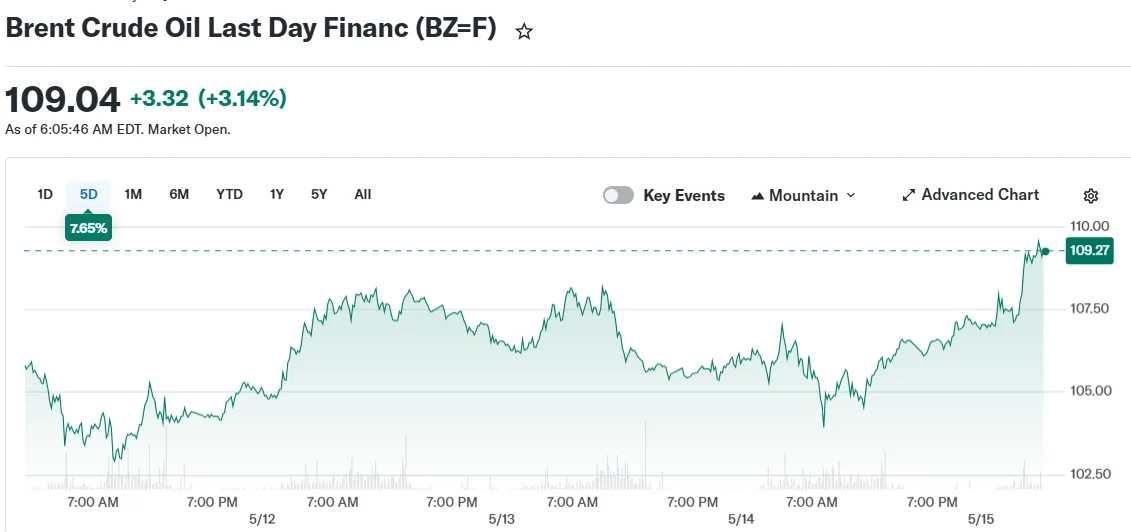
- Brent crude surged past $109 per barrel, marking nearly 8% weekly gains
- The vital Strait of Hormuz continues operating far below capacity with minimal tanker movement
- Trump issued stern warnings to Tehran, suggesting military options remain on the table
- The IEA projects global oil markets face severe supply deficits potentially lasting through October
- Trump-Xi talks in Beijing concluded without substantive agreements on energy or trade
Crude oil markets experienced a dramatic rally this week as the critical Strait of Hormuz remained disrupted and diplomatic initiatives to resolve the Iran standoff yielded minimal progress.
By Friday’s close, Brent crude had pushed beyond $109 per barrel, registering approximately 8% gains for the week. West Texas Intermediate hovered around $105. These benchmarks recorded their most substantial weekly advances in several months.
The Strait of Hormuz represents the globe’s most critical petroleum transit corridor. Approximately 20% of worldwide oil production typically passes through this narrow waterway.
Following the outbreak of hostilities in late February, vessel traffic through the strait experienced a precipitous decline. According to U.S. Energy Information Administration data, crude oil and refined product flows decreased by nearly 6 million barrels daily during the first quarter.
Iranian government media indicated roughly 30 ships navigated the passage this week. Nevertheless, maritime activity remains substantially depressed compared to historical norms, with shipping companies hesitant to restore regular operations given persistent security concerns.

Vitol Group, a major commodity trading firm, has begun marketing Iraqi crude—sourced from terminals bypassing Hormuz—to international buyers. This development indicates some export volumes have successfully found alternate pathways from the region.
Trump Loses Patience With Iran
President Trump adopted an aggressive stance toward Iran on Friday, declaring on Truth Social that the “military decimation of Iran (to be continued!)” During a Fox News appearance, he stated: “I am not going to be much more patient. They should make a deal.”
A temporary ceasefire implemented in early April remains technically active, though multiple violations have occurred. Washington and Tehran appear deeply divided on achieving any permanent settlement.
Trump recently characterized the fragile truce as hanging on by “massive life support.” Market analysts suggest the substantial disagreements between both nations increase the probability of renewed escalation rather than diplomatic resolution in the immediate future.
“The path of least resistance very near term for prices remains more to the bullish side as we continue to see crude oil and fuel inventories contract,” said Dennis Kissler, senior vice president at BOK Financial Securities.
The ongoing conflict has depleted worldwide petroleum stockpiles at an unprecedented rate. The International Energy Agency indicated this week that global markets may face “severely undersupplied” conditions extending through October, even assuming hostilities cease within the next month.
Trump-Xi Summit Ends Without Major Deal
President Trump conducted a two-day summit with Chinese President Xi Jinping in Beijing. Discussions encompassed the Iran conflict, energy supply security, and bilateral commercial relations.
Both heads of state acknowledged the necessity of maintaining open access through the Strait of Hormuz for worldwide energy distribution. Xi additionally signaled China’s willingness to increase purchases of U.S. crude oil as a strategy to diminish reliance on Middle Eastern supplies.
Xi reported that China and the United States achieved consensus on stabilizing commercial ties and enhancing dialogue on regional security matters. Chinese official media characterized the discussions as reaching “important consensus.”
Nevertheless, the summit failed to produce significant binding commitments. Trump mentioned Xi responded favorably to expanding American crude imports, though China’s official statement conspicuously omitted energy from the list of discussed subjects.
Friday additionally witnessed broad-based selling across fixed-income markets. Market participants expressed anxiety that petroleum supply chains will not normalize rapidly, potentially fueling inflationary pressures.
Physical crude trading has tightened considerably in recent sessions, underscoring the broader pressure on global energy infrastructure stemming from the continuing Middle East crisis.
Get 3 Free Stock Ebooks
Discover top-performing stocks in AI, Crypto, and Technology with expert analysis.
- Top 10 AI Stocks - Leading AI companies
- Top 10 Crypto Stocks - Blockchain leaders
- Top 10 Tech Stocks - Tech giants



