


TLDR
- Evernorth CEO Asheesh Birla says CLARITY may bring crypto activity back under U.S. regulatory oversight.
- The bill would define clear roles for banks, brokers, custodians, and exchanges in on-chain markets.
- Birla argues U.S. uncertainty pushed developers, funds, and custody work to overseas jurisdictions for years.
- The Act could shape rules for tokenized treasuries, funds, equities, and other traditional assets too.
- Stablecoin growth after GENIUS is used as an example of market response to clear rules.
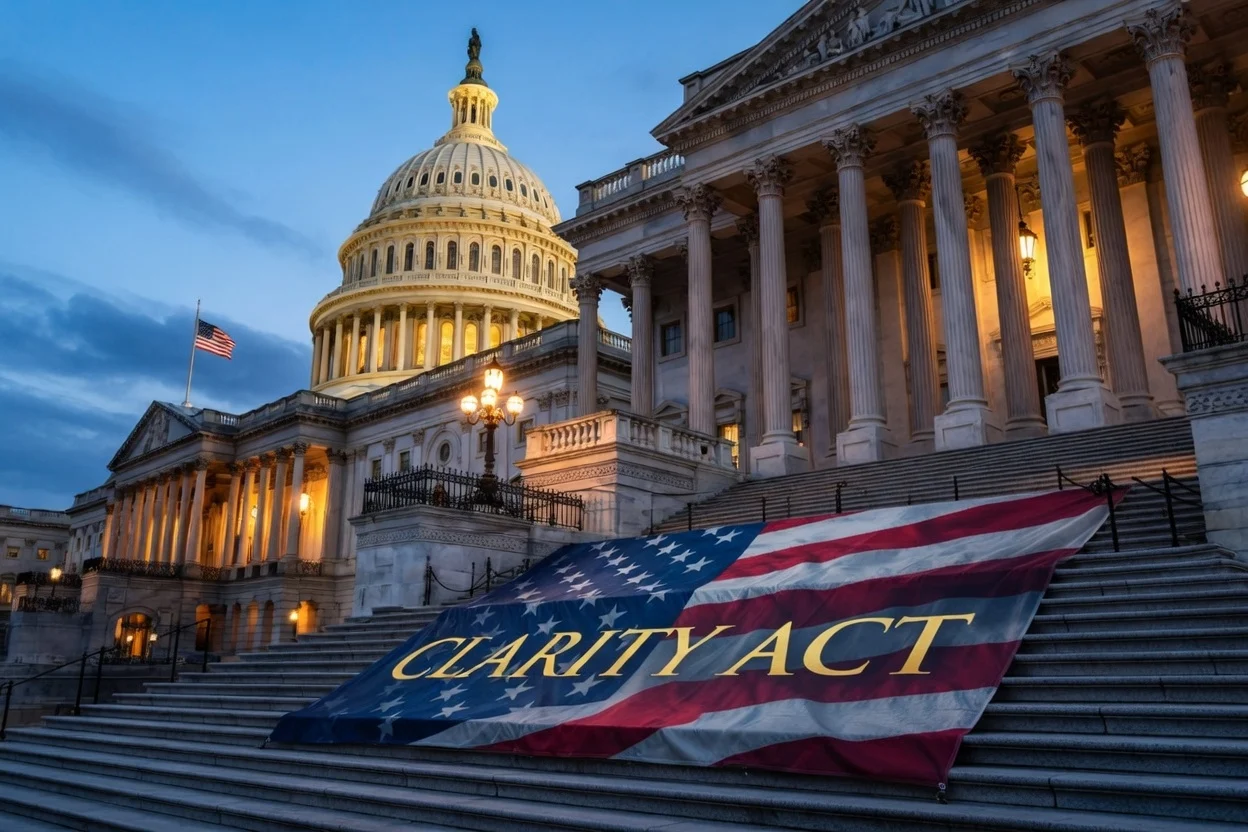
Evernorth CEO Asheesh Birla addressed the Digital Asset Market Clarity Act of 2025. He said it could help bring crypto activity back to the United States. The bill cleared markup before the Senate Banking Committee on May 14. The debate has focused on SEC and CFTC powers, but Birla pointed to market location.
CLARITY Act Moves Through Senate Process
Birla said the CLARITY Act gives U.S. firms a clearer path into digital asset markets. He said the bill addresses which agency oversees certain crypto assets. It also sets roles for trading, custody, and broker activity.
The measure lets broker-dealers broker, trade, or custody digital commodities and permitted payment stablecoins. It would also involve alternative trading systems and national securities exchanges. The bill also calls for rules on customer assets during firm failure or liquidation.
Birla said U.S. institutions have waited for a basic answer. He framed that answer as “who can do what, and under what supervisory regime?” The comment points to banks, brokers, custodians, and exchanges.
The bill is not final, and a markup does not make it law. However, Birla said it sends a clear signal from lawmakers. He said the United States wants to lead on-chain finance and not move it offshore.
Offshore Growth Raises U.S. Control Concerns
Birla argued that U.S. uncertainty has pushed crypto work to other markets. He said founders often choose Switzerland, Singapore, or the UAE to avoid unclear rules. He added that those firms are not rejecting U.S. capital markets.

He also pointed to data on developers and crypto funds. Electric Capital’s 2024 Developer Report said 81% of crypto developers work outside the United States. It also said North America’s share fell from 44% to 24% over ten years.
The 2025 AIMA Global Crypto Hedge Fund Report found 58% of crypto hedge funds domiciled in the Cayman Islands. The report placed the United States at 13%. Birla used those figures to show how markets moved while U.S. rules stayed unclear.
He also cited Abu Dhabi’s financial free zone. It reported a 67% yearly rise in new licenses in the first quarter of 2025. Birla named Binance and Plume among firms linked to that market. He said the risk continues, but U.S. oversight loses reach.
Tokenization Could Shape The Next Debate
Birla connected the CLARITY Act to a wider shift in finance. He said the bill could guide rules for tokenized treasuries, money market funds, equities, and other assets. These products form part of a broader move to settle assets on-chain.
He pointed to stablecoins as an example of what clear rules can do. He said the market rose above $300 billion after the GENIUS Act became law in July 2025. He also said stablecoin transaction volumes now rival Visa and PayPal.
The CLARITY Act covers a larger field, according to Birla. He said institutions are preparing to issue and settle many traditional assets on-chain. The bill could give those firms a U.S. path, with known rules and supervisors.
Birla said U.S. innovation is not seeking public support. “It wants a rulebook,” he said. He added that the bill does not decide what firms will build. It now sets where those answers may develop inside the U.S. rule system, its courts, and agencies.
Get 3 Free Stock Ebooks
Discover top-performing stocks in AI, Crypto, and Technology with expert analysis.
- Top 10 AI Stocks - Leading AI companies
- Top 10 Crypto Stocks - Blockchain leaders
- Top 10 Tech Stocks - Tech giants



