


TLDR
- Brian Armstrong, CEO of Coinbase, praised the revised Digital Asset Market Clarity Act before the Senate Banking Committee’s scheduled markup session
- David Sacks, serving as White House crypto policy director, described the upcoming markup as “a monumental step” in shaping American crypto regulations
- The proposed legislation addresses regulatory frameworks for stablecoins, decentralized finance protocols, trading platforms, and tokenized securities
- A pivotal agreement regarding stablecoin interest payments, negotiated by Senators Tillis and Alsobrooks, resolved a major roadblock that had delayed progress since early 2025
- Polling data from HarrisX reveals that 52% of American registered voters favor enacting the CLARITY Act
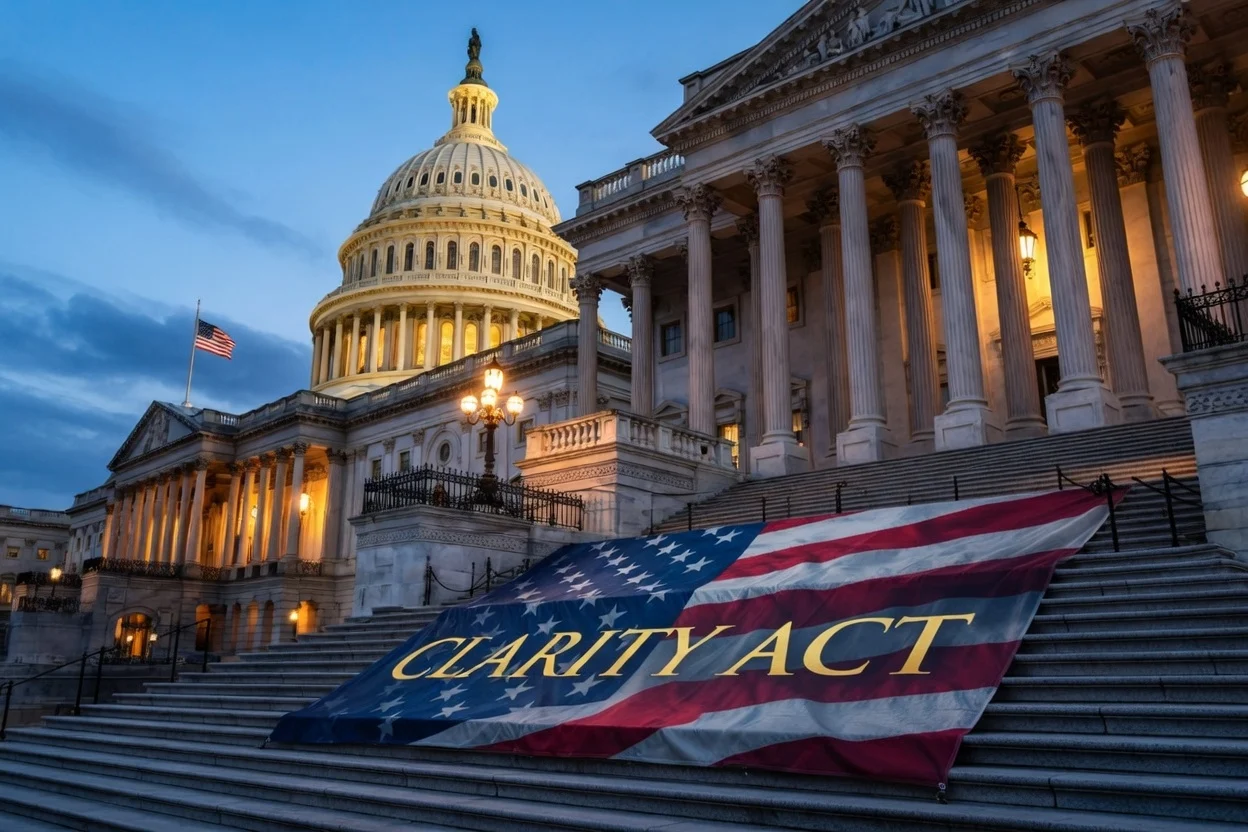
On May 14, 2026, the Senate Banking Committee will review the Digital Asset Market Clarity Act. This legislation, commonly referred to as the CLARITY Act, aims to establish a comprehensive federal regulatory structure governing cryptocurrency markets across America.
Brian Armstrong, who leads Coinbase, publicly endorsed the bill’s current iteration before the committee’s consideration. According to Armstrong, the legislation now stands in its “strongest and most bipartisan position” following extensive negotiations between traditional banking institutions and cryptocurrency industry representatives.
Armstrong characterized the outcome as a “healthy compromise” particularly regarding how stablecoin yield is handled. This breakthrough agreement, facilitated by Senators Tillis and Alsobrooks, addressed a critical sticking point that had prevented the bill’s advancement in January 2025.
The updated draft incorporates fresh language covering decentralized finance ecosystems, tokenized equity instruments, and expanded oversight powers for the Commodity Futures Trading Commission in digital asset markets.
White House Backs the Bill
David Sacks, who directs crypto policy from the White House, expressed his endorsement prior to Thursday’s committee session. Sacks framed the markup as a transformative milestone in establishing America as the “Crypto Capital of the World.”
Sacks emphasized that approximately 50 million Americans currently own or actively use crypto. According to him, this legislation would enable the cryptocurrency sector to “innovate and flourish for years to come.”

He acknowledged Senate Banking Committee Chairman Tim Scott, White House crypto director Patrick Witt, and the wider digital asset community for their contributions in advancing the measure.
Chairman Scott emphasized that families, entrepreneurs, investors, and innovators all require transparent regulatory guidelines for digital assets.
What the Bill Would Do
Should the CLARITY Act become law, it would establish regulatory parameters for digital asset trading venues, intermediaries, and market makers. These participants would be subject to Bank Secrecy Act obligations, encompassing anti-money laundering protocols and know-your-customer requirements.
The legislation would prohibit interest accrual on dormant stablecoin holdings. Nevertheless, the Tillis-Alsobrooks framework permits rewards connected to transactional usage.
The bill establishes criteria for determining when DeFi platforms qualify as genuinely decentralized. Platforms failing to meet these standards would face traditional financial institution compliance requirements.
According to the bill’s provisions, tokenized conventional assets cannot circumvent securities regulations merely by operating on blockchain infrastructure.
The Senate draft spans 309 pages and encompasses transparency requirements, digital security standards, market manipulation prohibitions, consumer safeguards, and quantum-resistant cryptography specifications.
Traditional banking associations continue to worry that the stablecoin provisions might impact bank deposit dynamics, despite restrictions on idle balance compensation.
The House of Representatives approved its version in July 2025. The Senate draft requires additional coalition-building before proceeding through the legislative process.
HarrisX polling data indicates 52% of registered American voters endorse the CLARITY Act, with just 11% in opposition. Separate research shows roughly 20% of Americans hold cryptocurrency investments.
Thursday’s committee session will demonstrate whether months of negotiation have produced sufficient consensus to advance the bill through subsequent Senate proceedings.
Get 3 Free Stock Ebooks
Discover top-performing stocks in AI, Crypto, and Technology with expert analysis.
- Top 10 AI Stocks - Leading AI companies
- Top 10 Crypto Stocks - Blockchain leaders
- Top 10 Tech Stocks - Tech giants



