



Key Takeaways
- The 21 million BTC hard cap, reinforced by the 2024 halving event, keeps restricting new supply entering circulation
- Expert projections place a mid-range target at $180,000 per BTC by 2029, with optimistic scenarios approaching $350,000
- Exchange-traded funds offering direct Bitcoin exposure have unlocked institutional capital through traditional investment vehicles
- Even conservative forecasts position BTC around $90,000 by 2029, underpinned by network security and mainstream adoption
- When all scenarios are weighted by probability, the average projection settles around $200,000 for late 2029
Bitcoin’s evolution from niche cryptographic experiment to mainstream financial instrument has fundamentally altered the conversation around digital assets. The question is no longer whether Bitcoin survives, but rather how dominant it becomes.
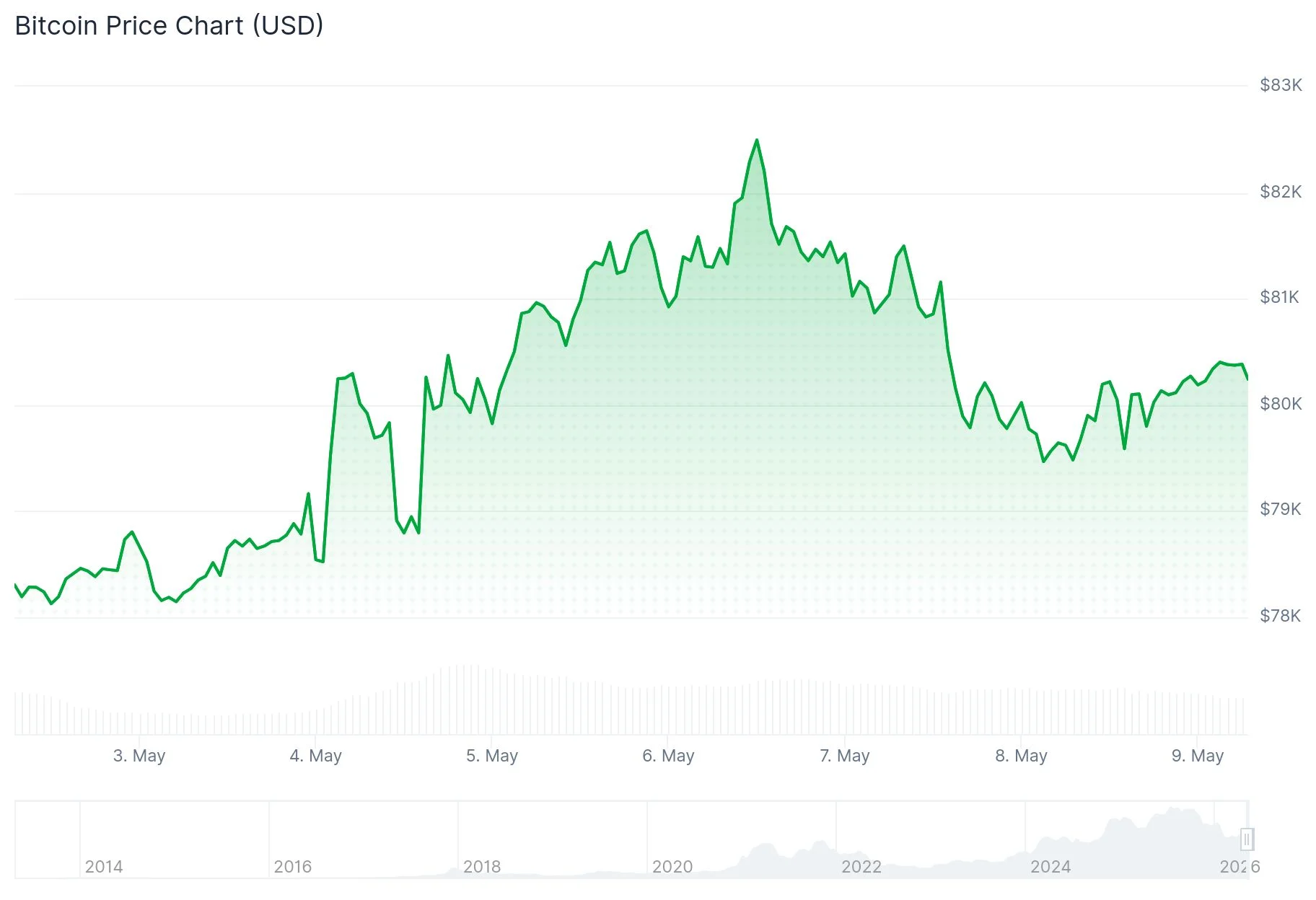
Financial analysts have begun constructing detailed price models extending to 2029, revealing a spectrum of possibilities that reflect different adoption pathways.
Bitcoin’s monetary policy continues to distinguish it from traditional assets. The protocol enforces a maximum supply of 21 million coins. Approximately 20 million have already been mined. Last year’s halving reduced block rewards from 6.25 to 3.125 BTC, with another reduction scheduled for 2028.
Historical patterns demonstrate that diminishing supply growth, when paired with increasing demand, has repeatedly catalyzed significant price appreciation for Bitcoin.
Three Distinct Trajectory Models
The moderate forecast positions Bitcoin near $180,000 by decade’s end. This valuation implies a network capitalization between $3.5 and $4 trillion. To provide perspective, gold’s aggregate market capitalization exceeds $20 trillion. Bitcoin need not fully displace precious metals to validate these projections—capturing even a fraction of that capital supports this baseline scenario.

This middle-ground outlook anticipates consistent capital flows into Bitcoin ETFs, broadening institutional participation, and Bitcoin maintaining between 45% and 55% dominance across cryptocurrency markets.
The optimistic projection extends toward the $300,000 to $350,000 range. Achieving these levels requires substantially deeper integration—pension fund allocations, sovereign wealth fund positions, and widespread corporate treasury adoption. Supporting these price points demands a market capitalization exceeding $7 trillion.
The conservative estimate places Bitcoin around $90,000 by 2029. This scenario emerges from stricter regulatory frameworks, diminished ETF enthusiasm, or competing blockchain networks capturing more market share than currently anticipated. Nevertheless, Bitcoin’s established brand recognition, network security architecture, and existing institutional footprint would likely preserve its cryptocurrency leadership position.
How ETF Approval Transformed Market Access
The regulatory approval of spot Bitcoin ETFs marked a pivotal infrastructure development. Previously, institutional participants faced significant operational friction—managing cryptographic keys internally or engaging with cryptocurrency-native platforms.
ETF structures eliminated this complexity. Traditional financial institutions can now gain Bitcoin exposure through familiar, regulated investment products.
This accessibility breakthrough has proven consequential. Capital allocation from conventional finance has expanded consistently since regulatory approval, with analysts identifying this as among the most significant long-term demand catalysts.
When probability weights are applied across all three scenarios, the expected value for Bitcoin approaches $200,000 by 2029.
Current market data confirms institutional ownership continues expanding, with ETF capital inflows maintaining momentum throughout 2025.
Get 3 Free Stock Ebooks
Discover top-performing stocks in AI, Crypto, and Technology with expert analysis.
- Top 10 AI Stocks - Leading AI companies
- Top 10 Crypto Stocks - Blockchain leaders
- Top 10 Tech Stocks - Tech giants



