


TLDR
- Brent crude advanced 0.5% to $100.51 per barrel on Friday; WTI climbed 0.4% to $95.19
- American and Iranian military forces clashed in the Strait of Hormuz on Thursday
- President Trump characterized the incident as a “trifle” while confirming the cease-fire continues
- Washington is evaluating the relaunch of “Project Freedom” to provide naval escorts through the waterway
- Both benchmarks remain lower for the week, declining from approximately $108 for Brent at Monday’s market open
Crude oil benchmarks climbed Friday morning following a military confrontation between American and Iranian forces in the strategically vital Strait of Hormuz, adding pressure to an already tenuous cease-fire agreement between the nations.
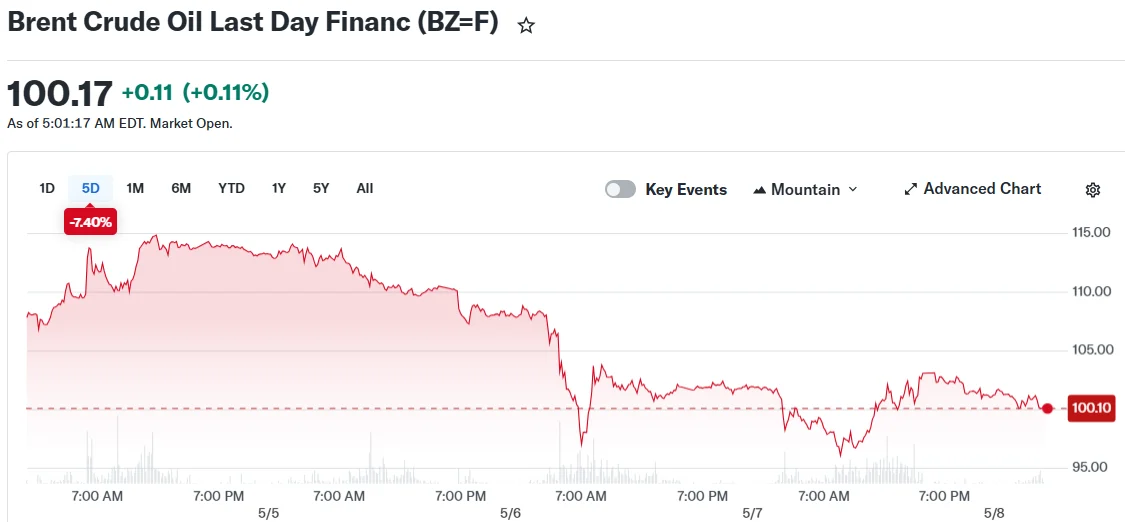
Brent crude futures advanced 0.5% to $100.51 per barrel during early European market hours. West Texas Intermediate futures increased 0.4% to reach $95.19 per barrel.
Both benchmarks had surged more than 2% earlier in the trading session. Brent temporarily exceeded $102 per barrel during Asian trading hours before retracting some of those gains.
Notwithstanding Friday’s upward movement, oil remains substantially lower for the week. Brent commenced Monday’s trading around $108 per barrel, with WTI near $100. This trajectory positions Brent for a weekly decline of approximately $7.
The Strait of Hormuz represents one of the globe’s most critical oil transportation corridors. Approximately 20% of worldwide oil supplies typically transit through this waterway.

Details of the Maritime Confrontation
Iran deployed missiles, unmanned aerial vehicles, and small watercraft in attacks targeting U.S. naval vessels positioned near the Strait of Hormuz, according to a U.S. Central Command statement cited by the Wall Street Journal.
U.S. military personnel successfully intercepted the incoming threats and conducted retaliatory strikes against Iranian military installations responsible for launching the attacks, the statement confirmed.
President Trump minimized the significance of the confrontation on Truth Social Thursday, labeling it a “trifle.”
“Just like we knocked them out again today, we’ll knock them out a lot harder, and a lot more violently, in the future, if they don’t get their Deal signed, FAST!,” Trump wrote.
Trump further affirmed that the cease-fire arrangement remains operational despite the military engagement.
Naval Escort Program and Diplomatic Efforts
The Trump administration is contemplating the resumption of “Project Freedom,” a naval operation designed to escort commercial shipping through the Strait of Hormuz, according to Wall Street Journal reporting.
The Strait has been essentially inaccessible to regular maritime traffic, Saxo Bank analysts indicated Friday. They characterized the week as showing an “almost $20 trading range as Middle East headlines swung sentiment between optimism and frustration.”
Market participants continue monitoring developments regarding a potential resumption of direct diplomatic negotiations between Washington and Tehran.
ING analyst Francesco Pesole noted in a research briefing that expectations exist for a potential agreement before the scheduled U.S.-China summit on May 14-15, though he emphasized “risks are clearly very binary.”
Pesole indicated that market confidence is “fading again” in the aftermath of the military clashes and the possibility of renewed U.S. escort operations.
Saxo Bank analysts highlighted that the fundamental challenge persists: “The Strait of Hormuz remains effectively closed, with renewed clashes between U.S. and Iranian forces lowering the prospect of a near-term reopening.”
As of early European trading Friday, Brent crude for July delivery advanced 0.6% to $100.67 per barrel. WTI futures for June increased 0.4% to $95.16 per barrel.
Get 3 Free Stock Ebooks
Discover top-performing stocks in AI, Crypto, and Technology with expert analysis.
- Top 10 AI Stocks - Leading AI companies
- Top 10 Crypto Stocks - Blockchain leaders
- Top 10 Tech Stocks - Tech giants



