


Quick Summary
- Shares of Maersk declined 7.5% in Copenhagen following first-quarter results
- First-quarter EBITDA reached $1.73bn, surpassing the $1.66bn analyst estimate but down from $2.71bn year-over-year
- Company maintains full-year outlook with global container volume growth expected at 2%–4%
- Iran’s Strait of Hormuz blockade driving up fuel expenses and operational costs
- Asia-Europe shipping rates have surrendered nearly all post-conflict gains
Danish shipping titan Maersk delivered first-quarter earnings that topped Wall Street expectations on Thursday, yet shares tumbled as market participants turned their attention to an increasingly challenging outlook ahead.
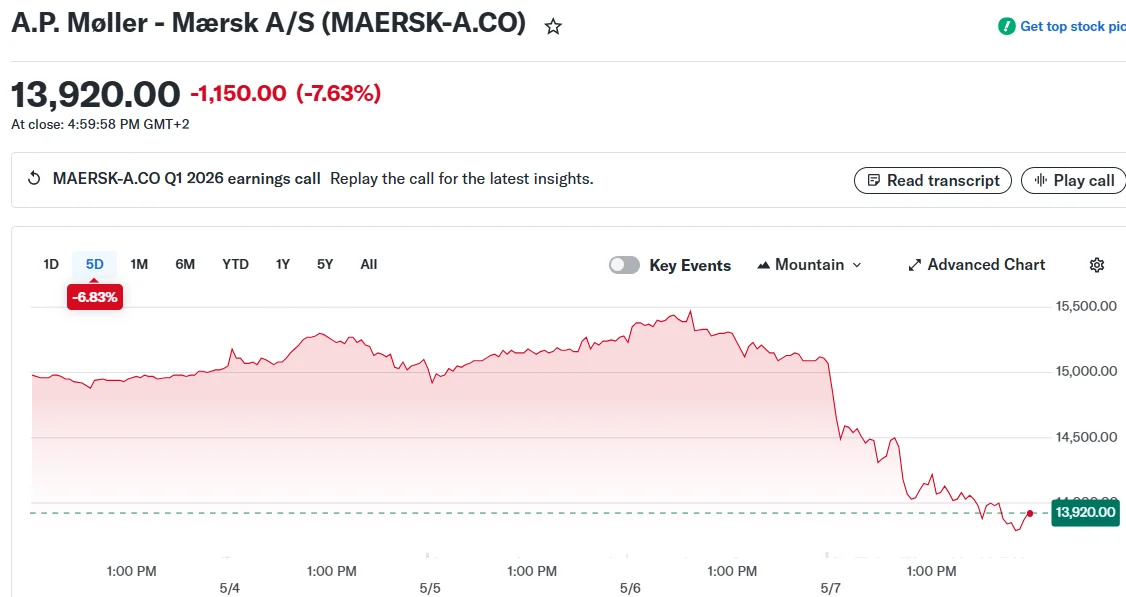
The Copenhagen-based logistics powerhouse posted first-quarter EBITDA of $1.73bn, exceeding the consensus forecast of $1.66bn from analysts. However, the result represented a significant decline from the $2.71bn recorded during the comparable quarter last year.
Shares tumbled 7.5% during Copenhagen trading sessions, significantly underperforming the broader market benchmark which remained relatively flat.
Shipping rates experienced consistent pressure throughout most of the quarter amid persistent capacity oversupply conditions. The rates only experienced a dramatic uptick in the final weeks of the period following the escalation of tensions with Iran in late February.
The conflict commenced on February 28 when the United States and Israel executed synchronized military operations against Iranian targets. Consequently, the Q1 financial results don’t completely capture the conflict’s disruption to international supply chains.

Tehran’s move to shut down the Strait of Hormuz for commercial shipping traffic has compelled carriers to alter routes, driving up fuel expenditures and creating widespread disruption across established maritime corridors throughout the sector.
Ongoing Conflict Maintains Cost Pressures
Maersk has shifted to routing vessels around the African continent, bypassing the Suez Canal and the Bab el-Mandeb Strait. This represents a strategic pivot from previous intentions to progressively restore certain services through the Suez corridor.
Chief Executive Vincent Clerc delivered frank commentary regarding the energy landscape. “The energy crisis does not go away the day peace comes,” he stated during media briefings, noting that petroleum companies anticipate sustained elevated costs lasting “at minimum several more months.”
The shipping company maintained its annual forecast, preserving its projection for worldwide container volume expansion of 2% to 4%. However, management cautioned that market conditions continue to exhibit significant volatility.
The organization highlighted that increased energy expenses and commercial restrictions affecting the Upper Gulf region — representing approximately 6% of global container commerce in 2025 — present downward pressure on the growth projection.
Wall Street Sees Constrained Potential
Morgan Stanley research team indicated they identify “limited scope for earnings upgrades” stemming from the quarterly update, with any forecast adjustments likely to mirror freight rate fluctuations.
They observed that pricing on principal European shipping lanes has essentially eliminated all appreciation recorded since the Iran conflict’s onset. Fresh vessel capacity continues to exceed demand growth — Maersk independently commissioned eight new ships during February.
Jyske Bank equity analyst Haider Anjum cautioned about a potential earnings reduction later this year. “Freight rate developments are not expected to be able to compensate for the higher fuel costs,” he noted in research commentary.
Morgan Stanley identified one possible positive catalyst: bunker fuel supply constraints, which might accelerate vessel idling across the industry. They acknowledged this dynamic hasn’t materialized in current market data but suggested it warrants close observation.
Maersk indicated it is attempting to transfer increased costs to clients, although the success of this strategy remains uncertain considering prevailing rate dynamics.
The Asia-Europe freight benchmark has essentially reverted to pre-conflict pricing levels, even while fuel expenses remain elevated — a dynamic that market observers suggest could compress profit margins during upcoming quarters.
Get 3 Free Stock Ebooks
Discover top-performing stocks in AI, Crypto, and Technology with expert analysis.
- Top 10 AI Stocks - Leading AI companies
- Top 10 Crypto Stocks - Blockchain leaders
- Top 10 Tech Stocks - Tech giants



