



Key Takeaways
- American equity futures declined Monday following Iranian media claims of missile strikes targeting a U.S. naval vessel in the Strait of Hormuz region
- Pentagon officials refuted the Iranian state media claims, helping to stabilize markets after initial volatility
- Crude oil prices jumped more than 3%, pushing Brent crude toward $112 per barrel
- President Trump unveiled “Project Freedom” to provide naval escort services through the strategic waterway; Iran issued warnings of countermeasures
- Friday’s April employment data release is anticipated to show approximately 60,000 jobs added
American equity futures experienced declines Monday morning following reports from Iranian state-controlled media outlets claiming missiles had impacted a U.S. naval vessel operating near the Strait of Hormuz. The claims sparked initial market turbulence before American military officials issued denials.
Contracts linked to the Dow Jones Industrial Average decreased approximately 204 points, representing a 0.4% decline. Futures for the S&P 500 retreated 0.2%, while Nasdaq 100 contracts pulled back 0.1%.
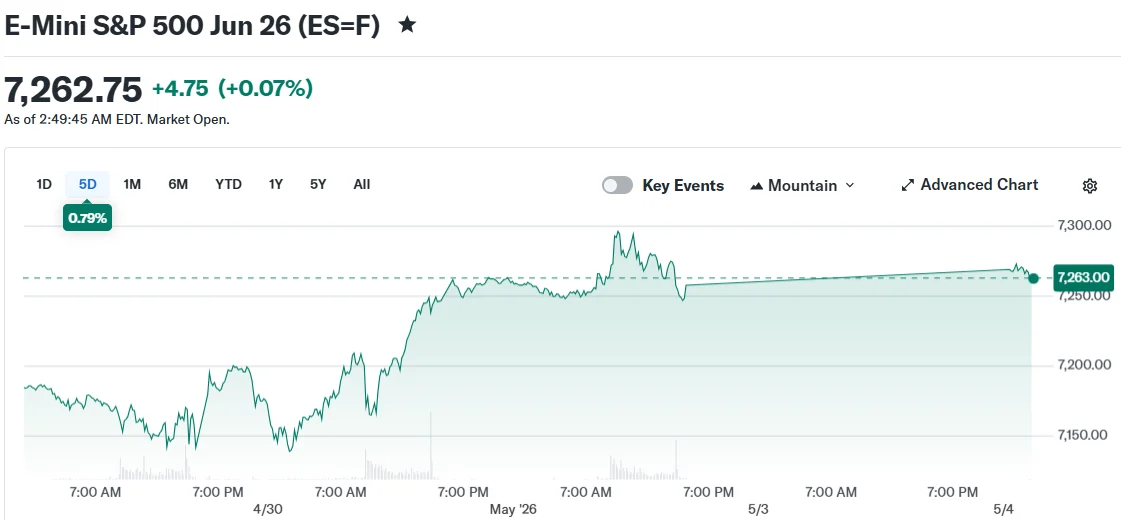
Both the S&P 500 and Nasdaq had achieved record closing levels Friday, completing their strongest five-week period since May 2020. However, that positive momentum faced headwinds Monday morning due to geopolitical developments.
Fars News Agency, an Iranian outlet, reported that two missiles struck a U.S. frigate after the vessel allegedly disregarded warnings against entering the Strait of Hormuz. U.S. Central Command quickly responded via social media platform X, stating definitively that no naval vessels had sustained damage.
The official denial helped restore some market stability, though apprehension persisted. Market participants redirected capital toward traditional safe-haven instruments, driving the dollar index up 0.3% relative to major global currencies.

The benchmark 10-year Treasury note yield increased by 4 basis points to reach 4.41%, indicating investors were repositioning into lower-risk holdings.
Crude Oil Markets Rally on Supply Chain Concerns
Oil markets demonstrated significant sensitivity to the developments. Brent crude futures surged 3.4% to reach $111.80 per barrel. West Texas Intermediate rose 3.5% to $105.35 per barrel during morning trade.
The Strait of Hormuz represents one of the planet’s most strategically vital maritime corridors. A substantial portion of worldwide petroleum exports traverse this narrow passage, making any military activity in the area a pressing concern for energy sector participants.
Presidential Initiative “Project Freedom” Escalates Regional Tensions
Over the weekend, President Trump announced the United States would commence naval escort operations for commercial vessels stranded in the contested waterway. He designated this initiative “Project Freedom.”
The President issued a warning through social media channels that any attempts to interfere with the operation would receive a “forceful response.” Iranian officials countered with their own threats directed at American naval assets operating in regional waters.
The escalating rhetoric between the two nations heightened the possibility of direct military engagement and maintained trader anxiety throughout morning trading hours.
On the corporate front, quarterly earnings season progresses this week. Financial results are scheduled from semiconductor sector companies including Lattice Semiconductor, Advanced Micro Devices, and Arm Holdings.
Palantir and Paramount Skydance will also release their quarterly performance data in coming days.
Friday will bring the April U.S. employment situation report. Economic analysts are projecting a modest 60,000 jobs added, representing a significant decline from March’s 178,000 figure. The unemployment rate is forecast to remain steady at 4.3%.
The swift denial issued by U.S. Central Command regarding Iranian strike allegations served as the primary factor preventing deeper losses in equity futures during early Monday market activity.
Get 3 Free Stock Ebooks
Discover top-performing stocks in AI, Crypto, and Technology with expert analysis.
- Top 10 AI Stocks - Leading AI companies
- Top 10 Crypto Stocks - Blockchain leaders
- Top 10 Tech Stocks - Tech giants



