


Key Takeaways
- Compromise language for the CLARITY Act prohibits stablecoin issuers from providing yield based exclusively on passive holding
- Platforms may continue offering rewards connected to genuine user engagement and network participation
- Senators Angela Alsobrooks and Thom Tillis reached the agreement following extensive negotiations
- Coinbase leadership endorsed the compromise, with CEO Brian Armstrong urging lawmakers to “Mark it up”
- Prediction markets on Polymarket now estimate a 55% probability of passage in 2026, reflecting a 9% jump in one day
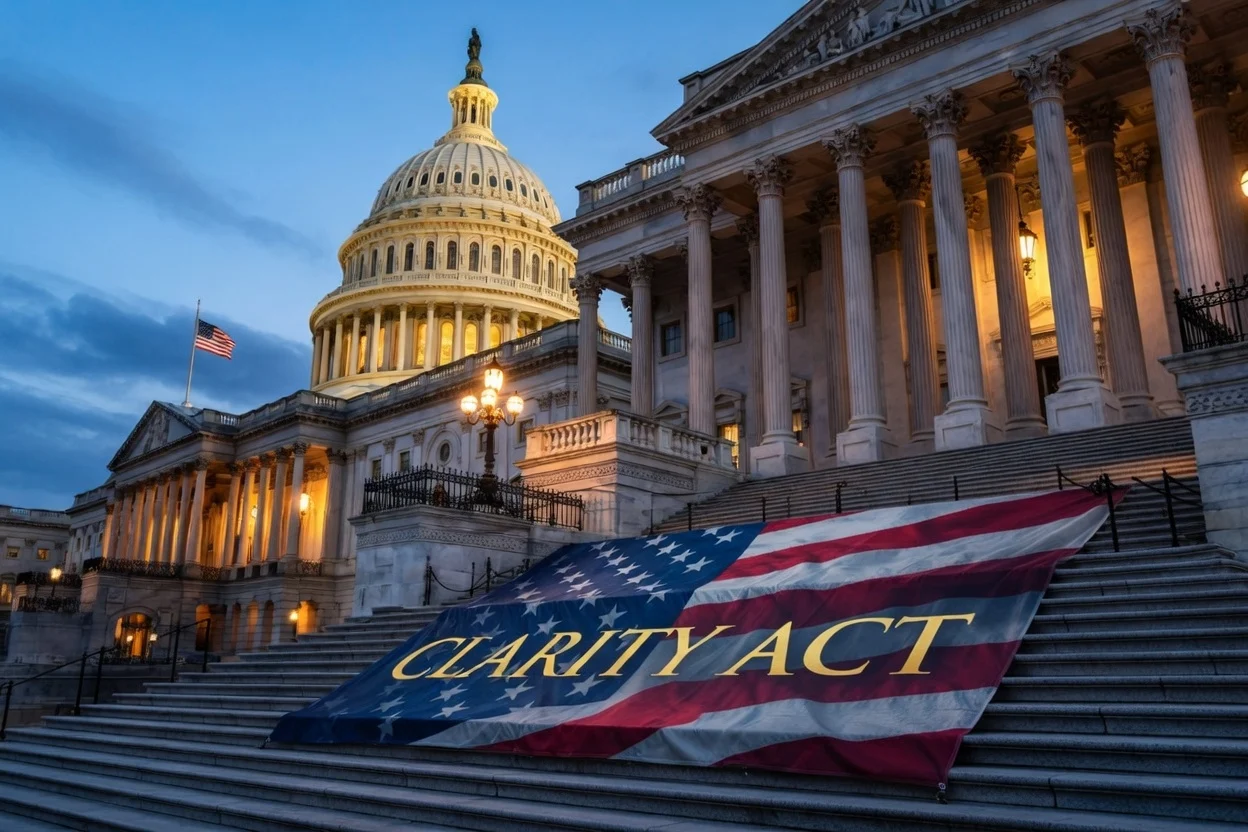
A prolonged disagreement between traditional financial institutions and cryptocurrency companies regarding stablecoin yields has reached resolution, eliminating a significant obstacle to the Digital Asset Market Clarity Act’s advancement.
Senators Angela Alsobrooks and Thom Tillis unveiled revised legislative language Friday that prohibits cryptocurrency platforms from distributing interest or yield to users based solely on stablecoin ownership.
Traditional banks expressed concern that yield-generating stablecoin products would function similarly to deposit accounts, diverting capital from conventional financial institutions and constraining their lending capacity.
The negotiated agreement prevents crypto companies from providing returns that are “economically or functionally equivalent” to interest earned on traditional bank deposits.
Nevertheless, the compromise permits incentives linked to what the legislation defines as “bona fide activities.” This provision enables users to receive compensation through active engagement with cryptocurrency platforms and blockchain networks, rather than through passive asset accumulation.
Coinbase participated extensively in the negotiation process and faced the greatest implications from the outcome. Chief Policy Officer Faryar Shirzad acknowledged that banking interests secured more limitations than crypto advocates preferred, though the fundamental capacity to provide activity-based incentives remained intact.

Coinbase CEO Brian Armstrong shared a concise statement on X: “Mark it up.” Chief Legal Officer Paul Grewal emphasized that the framework “preserves activity-based rewards tied to real participation on crypto platforms and networks.”
Operational Implications for Cryptocurrency Companies
An industry insider noted that platforms will need to transition from a passive “buy and hold” approach to an active “buy and use” framework to meet the criteria for permissible rewards under the updated regulations.
The legislative text mandates the Treasury Department and Commodity Futures Trading Commission to initiate rulemaking procedures within twelve months of enactment. This regulatory process will establish clearer definitions of qualifying activities for reward programs.
Regulatory authorities will have discretion to evaluate factors including account balance, holding duration, and the characteristics of user activities when developing these standards. The text incorporates anti-circumvention provisions as well.
Legislative Schedule and Senate Actions
Galaxy Digital research director Alex Thorn indicated that publication of the compromise text suggests the Senate Banking Committee may schedule a markup session “as soon as the week of May 11.”
Thorn additionally cautioned that banking sector opposition is anticipated to intensify following release of the final legislative language.
Senator Bernie Moreno recently projected the legislation would reach completion by May’s conclusion. Senator Cynthia Lummis stated on April 11, “It’s now or never.”
The Clarity Act experienced delays earlier this year when a scheduled markup session was abruptly postponed in January.
Polymarket prediction markets currently assign the CLARITY Act a 55% likelihood of presidential signature and enactment during 2026.
President Donald Trump has designated cryptocurrency regulatory reform as a key objective during his second administration. Digital asset companies have historically operated within uncertain regulatory parameters, which industry leaders contend has restricted business development opportunities.
Get 3 Free Stock Ebooks
Discover top-performing stocks in AI, Crypto, and Technology with expert analysis.
- Top 10 AI Stocks - Leading AI companies
- Top 10 Crypto Stocks - Blockchain leaders
- Top 10 Tech Stocks - Tech giants



