



Key Highlights
- Blockchain-based real-world assets expanded more than 420% from January 2025, surpassing $30.2 billion
- US Treasury tokenization skyrocketed from $3.9 billion to beyond $15 billion, dominating sector expansion
- Gold-backed digital tokens recorded $90.7 billion in spot trading during Q1 2026
- Europe’s MiCA regulations and clearer frameworks boosted institutional participation
- Equity tokenization expanded from $2 million to approximately $487 million in market capitalization
The market for tokenized real-world assets has experienced explosive expansion, climbing from $5.8 billion in early 2025 to surpass $30.2 billion by late April 2026, data from analytics platform RWA.xyz reveals. This represents an extraordinary increase exceeding 420% across approximately 16 months.
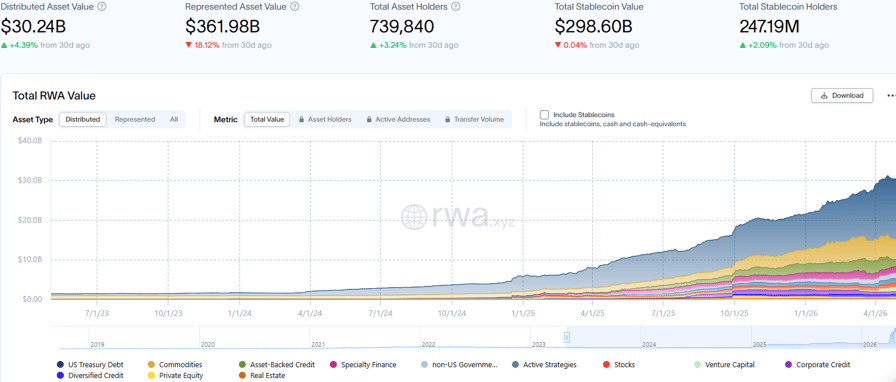
Tokenized United States Treasury securities powered the majority of this remarkable expansion. This asset category surged from $3.9 billion to exceed $15 billion, establishing itself as the dominant force within the tokenized asset ecosystem. Treasury products now represent more than half of the sector’s entire market capitalization growth during this timeframe.
BlackRock’s USD Institutional Digital Liquidity Fund, commonly referred to as BUIDL, debuted in March 2024. The product provides investors with blockchain-based exposure to short-duration US government securities. Fidelity entered the space in September 2025, launching the Fidelity Digital Interest Token as its competing tokenized offering.
Dominick John, who serves as an analyst with Zeus Research, explained that tokenized Treasury products essentially transform blockchain networks into distribution infrastructure for institutional capital flows. According to John, market dynamics have transitioned away from speculative investment patterns toward yield-focused capital deployment.
Regulatory developments have contributed significantly to market maturation. The European Union’s Markets in Crypto-Assets Regulation has facilitated traditional finance institutions’ entry into blockchain-based products. Zhong Yang Chan, head of research at CoinGecko, noted that tokenization momentum has “noticeably accelerated” as pilot programs evolved into mainstream operational frameworks.

Commodity Tokenization Gains Momentum with Gold Leading Charge
Tokenized commodity products emerged as another high-performing segment. Their combined market capitalization reached $5.55 billion by Q1 2026’s conclusion, representing 289% growth from $1.43 billion. Gold-backed tokens issued by Tether and Paxos comprise 89.1% of this category.

Spot trading volume for tokenized Gold products hit $90.7 billion throughout Q1 2026 exclusively. This quarterly figure exceeded the entire 2025 annual volume of $84.64 billion. Market observers attribute this surge to escalating Gold prices fueled by geopolitical uncertainties and expanded accessibility through major exchanges including Binance.
Trading activity demonstrates notable volatility. Volume peaked above $21 billion during October 2025 when Gold prices reached all-time highs, subsequently declining to approximately $14 billion in the subsequent month.
Equity and ETF Tokenization Shows Promise Despite Modest Scale
Tokenized equity securities expanded from a modest $2 million market capitalization in mid-2025 to approach $487 million by Q1 2026’s end. Circle dominates this segment at $173 million, with Tesla following at $61.7 million, Nvidia at $42.6 million, and Alphabet at $36.9 million.
Notwithstanding this impressive growth trajectory, tokenized stock trading volume continues representing less than 1% of conventional financial market activity.
Tokenized exchange-traded fund products reached nearly $300 million by Q1 2026’s conclusion, advancing substantially from merely $620,000 in July 2025.
John from Zeus Research emphasized that continued sector expansion hinges on whether tokenized equities, investment funds, and private credit instruments can achieve meaningful scale. ARK Invest projects the broader digital asset market could attain $28 trillion valuation by 2030.
Get 3 Free Stock Ebooks
Discover top-performing stocks in AI, Crypto, and Technology with expert analysis.
- Top 10 AI Stocks - Leading AI companies
- Top 10 Crypto Stocks - Blockchain leaders
- Top 10 Tech Stocks - Tech giants



