


Key Highlights
- BTC declined beneath $70,000 following the Federal Reserve’s decision to maintain current interest rates with projections showing only one 2026 rate reduction.
- Federal Reserve officials elevated their 2026 inflation projection to 2.7%, pointing to escalating crude oil costs linked to Middle Eastern hostilities.
- Oil prices jumped beyond $110 per barrel following Iranian strikes on regional energy infrastructure.
- Veteran Bitcoin holders liquidated more than 1,650 BTC valued at approximately $117 million during the selloff.
- Widespread declines hit cryptocurrency markets, equities, and precious metals, with the Nasdaq declining 1.5% and Ether losing over 6%.
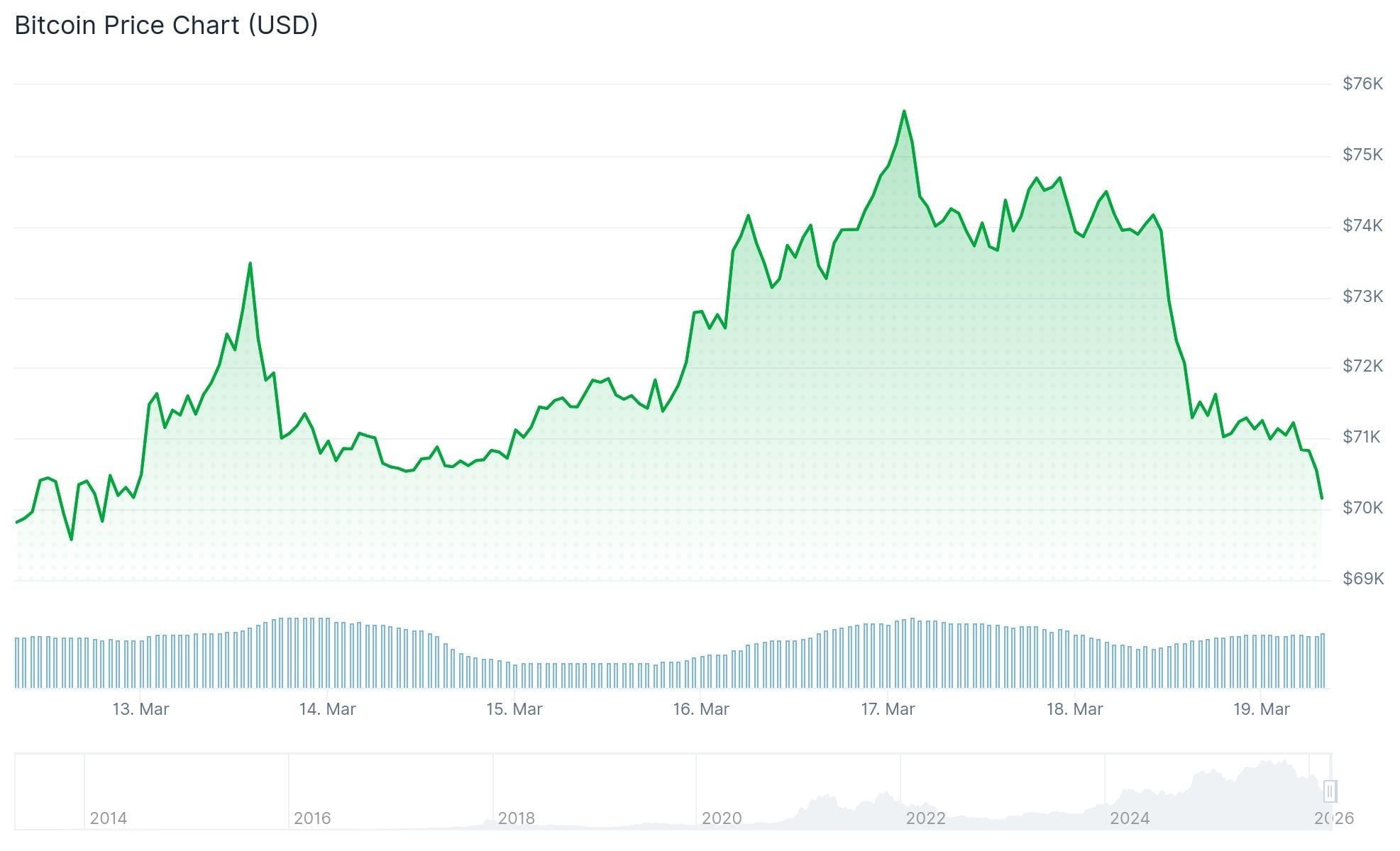
Bitcoin (BTC) experienced a significant downturn this week, dropping beneath the $70,000 threshold following the Federal Reserve’s announcement to maintain current interest rates while indicating a more gradual approach to future rate reductions than market participants anticipated.
The Federal Reserve maintained its policy rate within the 3.5%–3.75% corridor. However, the primary source of concern for market participants stemmed from Chairman Jerome Powell’s messaging during the post-meeting briefing.
Powell highlighted escalating crude oil costs as an emerging inflationary threat. “The oil shock for sure shows up,” he stated, acknowledging its impact on the central bank’s economic projections.
The Federal Reserve elevated its 2026 inflation projection to 2.7%, a notable increase from the previously forecasted 2.4%. This upward revision alarmed market participants who had anticipated continued disinflation.
The central bank’s summary of economic projections, commonly referred to as the “dot plot,” now indicates a consensus expectation of merely one rate reduction in 2026. Just weeks earlier, financial markets had priced in the likelihood of two to three cuts.

Prediction markets on Polymarket and CME Fed funds futures contracts adjusted rapidly. The likelihood of only a single rate cut this calendar year surged to approximately 80%, compared to a 38% probability just one month earlier.
Crude Oil Rally Intensifies Market Pressure
Oil prices had been climbing even before the Federal Reserve’s policy announcement. Crude oil soared above $110 per barrel following Iranian military operations targeting energy infrastructure throughout the Middle East, in retaliation for attacks on its South Pars gas extraction facility.
Elevated oil prices drove Treasury yields higher and bolstered the U.S. dollar, which typically creates headwinds for risk-oriented assets such as Bitcoin.
The Bank of Japan similarly maintained its policy rate on Thursday and identified Middle Eastern geopolitical tensions as a potential threat to Japan’s inflation trajectory.
Bitcoin had been trading comfortably above $74,000 during the earlier part of the week, momentarily approaching the $76,000 level. By Thursday morning, it had retreated to approximately $70,817, representing a decline of roughly 4.2% over a 24-hour period.
Ether experienced losses exceeding 6%, while XRP, Solana, and Dogecoin all recorded declines ranging from 3% to 5%. The CoinDesk 20 Index contracted by 3%.
Early Bitcoin Holders Liquidate Over $117 Million in Holdings
On-chain analytics monitored by Lookonchain revealed that a minimum of two veteran Bitcoin holders liquidated positions during the market decline.
One early adopter who had previously divested an 11,000 BTC position sold an additional 650 BTC. A second long-term holder maintaining a 5,000 BTC portfolio liquidated the entirety of a 1,000 BTC holding.
Combined, these two transactions represented over 1,650 BTC with a market value exceeding $117 million.
Cryptocurrency-related equity securities also experienced sharp declines. Strategy (MSTR) and Bitmine (BMNR) fell between 5% and 6%. Galaxy (GLXY) declined nearly 7%, while Gemini (GEMI) plummeted 15%, reaching its lowest valuation since its public market debut.
Gold similarly extended its losing streak, declining 3.1% to trade below $4,850 per ounce—its weakest price point in more than a month.
Powell rejected analogies to 1970s-era stagflation, emphasizing that unemployment remains near historical norms and inflation sits only modestly above target levels. Financial markets are now anticipating a more restrictive monetary policy environment throughout the remainder of 2026.
Get 3 Free Stock Ebooks
Discover top-performing stocks in AI, Crypto, and Technology with expert analysis.
- Top 10 AI Stocks - Leading AI companies
- Top 10 Crypto Stocks - Blockchain leaders
- Top 10 Tech Stocks - Tech giants



