


Key Highlights
- Bitcoin maintains position around $69,639 with a 1.2% gain despite escalating Middle East geopolitical tensions
- Crude oil surged past the $100 per barrel threshold following US military action that destroyed 16 Iranian vessels in the Strait of Hormuz region
- Equity futures showed weakness on Thursday with Dow, S&P 500, and Nasdaq contracts declining approximately 0.9–1%
- February’s Consumer Price Index registered at 2.4% annually, aligning with analyst predictions, though markets now focus on potential oil-related inflation pressures
- Congressional representatives continue negotiations to advance the crypto CLARITY Act amid discussions regarding stablecoin yield regulations
Bitcoin maintained its position near $69,639 during Wednesday’s trading session, registering a 1.2% daily increase. This performance occurred as international markets digested heightened geopolitical risks in the Middle East alongside US inflation figures that aligned with market expectations.
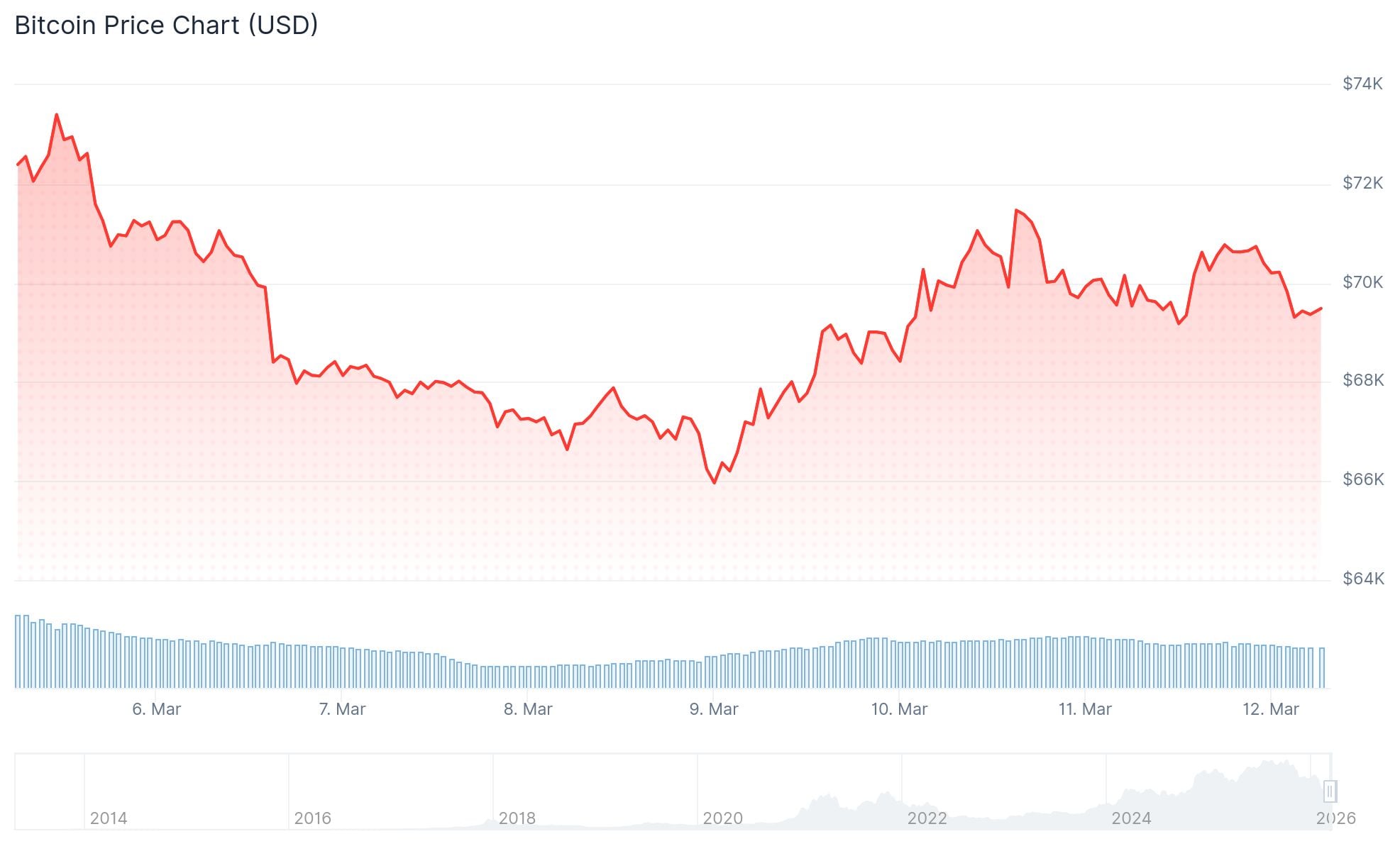
The aggregate cryptocurrency market valuation remained stable around $2.38 trillion, mirroring the levels observed at 2024’s conclusion.
According to Nexo Dispatch analyst Dessislava Ianeva, funding rates remain “neutral to slightly positive” throughout major digital assets, indicating that market leverage remains under control. Bitcoin perpetual open interest currently stands at approximately $28 billion, remaining beneath its October 2025 high.
Ethereum climbed 1.2% to reach $2,067. XRP experienced a modest 0.1% increase to $1.39. Solana advanced 1.2% while Cardano posted a 0.4% gain.
Crude Oil Breaches $100 Threshold Amid Iran Military Confrontation
US military forces allegedly destroyed 16 Iranian vessels believed to be deploying mines in the vicinity of the Strait of Hormuz. Additionally, two petroleum tankers suffered attacks in the Iraq Ports loading zone, prompting Iraqi authorities to suspend port operations.

Both West Texas Intermediate and Brent crude exceeded the $100 per barrel mark during Thursday’s overnight session, following gains exceeding 4% in Wednesday’s settlement. Earlier this week, oil prices had momentarily approached the $120 per barrel level.
The International Energy Agency declared that member nations would deploy approximately 400 million barrels from strategic reserves in a record-breaking release, yet prices maintained their upward trajectory.
President Trump stated Wednesday that the United States intends to “finish the job” in the coming period.
Equity Futures Decline as Market Participants Exercise Caution
US equity futures retreated during early Thursday trading. Dow futures decreased 1%. Both S&P 500 and Nasdaq 100 contracts fell roughly 0.9%.
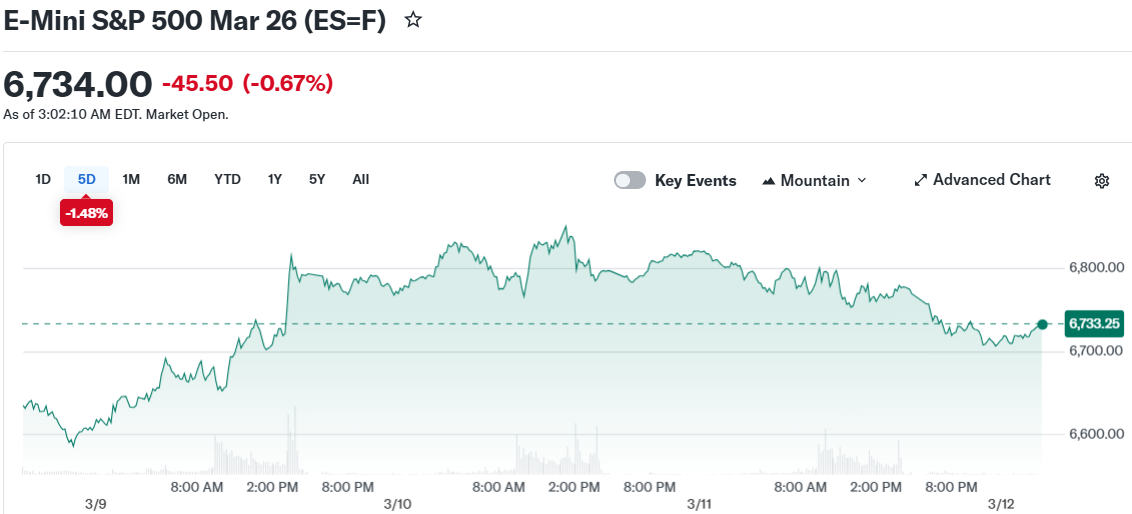
This marked the second consecutive session of predominantly negative performance on Wall Street.
February’s Consumer Price Index increased 0.3% on a monthly basis and 2.4% year-over-year, matching economist projections. Core inflation metrics, excluding volatile food and energy components, registered at 2.5% on an annual basis.
Wells Fargo economist Sarah House observed that February’s inflation report may already appear outdated, considering oil prices have surged approximately 25% since the previous month’s conclusion.
Market participants anticipate no policy adjustment at the Federal Reserve’s March 18 meeting. September remains the anticipated timing for the next reduction, with roughly a 43% probability of an additional cut materializing before the year concludes.
Adobe and Dollar General are scheduled to release quarterly earnings following Thursday’s market close.
In the nation’s capital, Senate members are investigating potential compromise solutions for the crypto CLARITY Act, particularly concerning regulations governing stablecoin yield provisions. The proposed legislation seeks to establish more transparent regulatory frameworks for digital asset oversight.
Get 3 Free Stock Ebooks
Discover top-performing stocks in AI, Crypto, and Technology with expert analysis.
- Top 10 AI Stocks - Leading AI companies
- Top 10 Crypto Stocks - Blockchain leaders
- Top 10 Tech Stocks - Tech giants



