



TLDR
- Energy prices rocketed beyond $116 per barrel following U.S.-Israeli military operations dubbed “Operation Epic Fury” that shook international oil markets
- More than $2 trillion vanished from U.S. stock futures during Monday’s early trading session
- Bitcoin dropped under the $66,000 threshold while Ethereum declined to $1,960 as cryptocurrency markets shed $40 billion throughout the weekend
- Investors await Wednesday’s February CPI inflation report, followed by Friday’s PCE index release
- Markets currently price in a 95.5% chance of no interest rate adjustment at the Federal Reserve’s March 18 policy meeting
Energy markets experienced severe turbulence Monday as crude oil reached $116 per barrel, driven by military actions connected to “Operation Epic Fury.” The dramatic price movement followed escalating U.S.-Israeli operations against Iran, sparking concerns about potential supply chain interruptions through the strategically vital Strait of Hormuz.
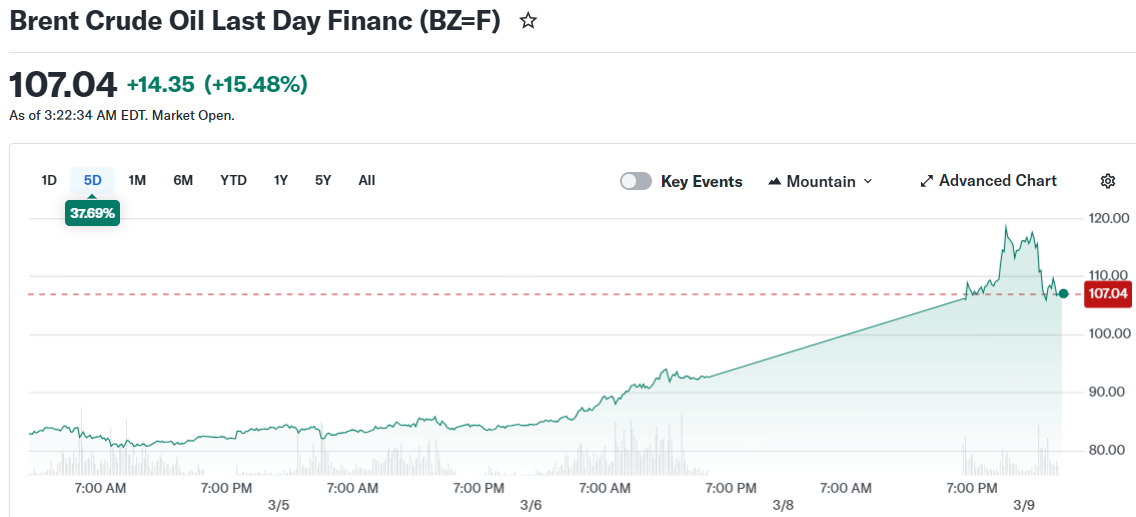
West Texas Intermediate crude experienced a remarkable 22% surge during the opening hours of Monday’s session. Brent crude followed suit with similarly sharp gains, as market experts cautioned that constrained vessel movement through the Strait of Hormuz — a critical chokepoint responsible for approximately 20% of worldwide oil transport — could sustain elevated pricing.
On March 8, President Donald Trump took to Truth Social to address the energy price surge, stating: “Short term oil prices, which will drop rapidly when the destruction of the Iran nuclear threat is over, is a very small price to pay for U.S.A., and world, safety and peace.”
The nationwide average for gasoline in the United States stood at approximately $3.45 per gallon before advancing higher as energy market instability intensified.
Experts from Rystad Energy cautioned that even following a resolution to the Iranian nuclear situation, crude prices may remain anchored near the $100–$110 range for a considerable timeframe due to persistent navigation hazards throughout the Persian Gulf region.
Stock and Crypto Markets React
Equity futures in the United States saw more than $2 trillion in valuation evaporate during Monday’s pre-market hours. The Kobeissi Letter characterized the event as “one of those days that will be referenced for decades to come,” highlighting that 20 million barrels of daily oil production went offline with no indication of conflict de-escalation.

Digital asset markets lost $40 billion in value throughout the weekend period, reducing aggregate market capitalization to $2.36 trillion. Bitcoin encountered selling pressure at the $68,000 level Sunday and subsequently declined beneath $66,000 before experiencing modest gains during Monday’s Asian trading hours.
Ethereum struggled to maintain support above the $2,000 threshold over the weekend and traded at $1,960 at press time. The majority of alternative cryptocurrencies showed minimal movement across the previous 24-hour period.
Risk-sensitive assets such as cryptocurrencies typically respond swiftly to geopolitical turbulence, and recent market behavior proved consistent with this pattern.
Inflation Data Adds Pressure This Week
The Consumer Price Index report for February arrives Wednesday. Given escalating fuel costs, market observers anticipate inflation metrics will register elevated readings.
The Federal Reserve’s primary inflation indicator, January’s Personal Consumption Expenditures index, releases Friday. Projections suggest a 0.4% monthly gain, mirroring December’s increase and representing consecutive months of elevated inflation.
The Federal Reserve convenes for its policy meeting March 18. Based on CME Group futures pricing, markets assign a 95.5% likelihood that policymakers maintain current interest rate levels at that gathering.
Internal Federal Reserve deliberations have acknowledged that persistent elevated energy expenses could introduce additional complexity to upcoming monetary policy determinations.
Get 3 Free Stock Ebooks
Discover top-performing stocks in AI, Crypto, and Technology with expert analysis.
- Top 10 AI Stocks - Leading AI companies
- Top 10 Crypto Stocks - Blockchain leaders
- Top 10 Tech Stocks - Tech giants



