
The price dynamics of Dogecoin are entering a new phase as its long-standing relationship with Bitcoin begins to weaken. Historically, DOGE has closely followed Bitcoin’s broader market movements, but the recent drop in correlation suggests the memecoin may now be driven more independently.
At the same time, mixed on-chain signals are emerging as uncertain for Dogecoin. With key technical levels approaching and sentiment shifting, the question now arises whether DOGE is preparing for a fresh rally or facing the risk of deeper downside.
Dogecoin Says Goodbye To Bitcoin, Faces Outflows
The correlation between Dogecoin and Bitcoin has weakened significantly, with the coefficient falling to around 0.44. Earlier in the period, the metric approached 1.0, indicating that DOGE was moving almost perfectly in line with Bitcoin’s price action, reflecting strong market-wide sentiment and capital flow from BTC into altcoins.
The steady decline since mid-February suggests Dogecoin is gradually decoupling from Bitcoin’s influence. While a 0.44 correlation still represents a moderate relationship, it implies DOGE is responding to its liquidity flows, speculation, and memecoin-driven demand.
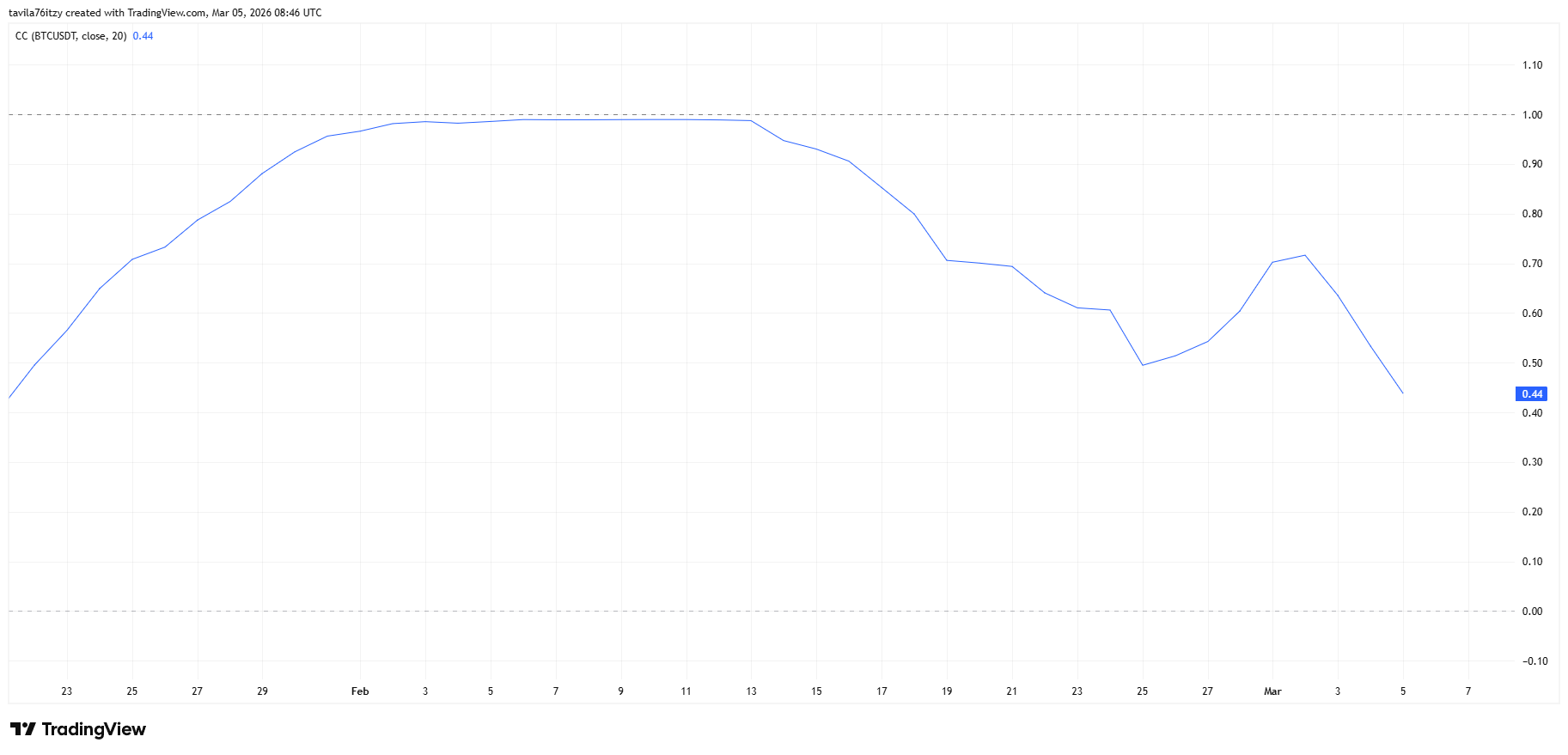
Dogecoin Correlation To Bitcoin – Source – TradingView

CMF for Dogecoin is currently around -0.12, remaining below the zero line for most of the period. Negative CMF values indicate that capital outflows and selling pressure dominate, suggesting that holders have been distributing DOGE rather than accumulating it.
Although the indicator briefly moved into positive territory in mid-February, those inflows were short-lived and quickly reversed, signaling weak buying conviction and an inability to sustain bullish momentum.
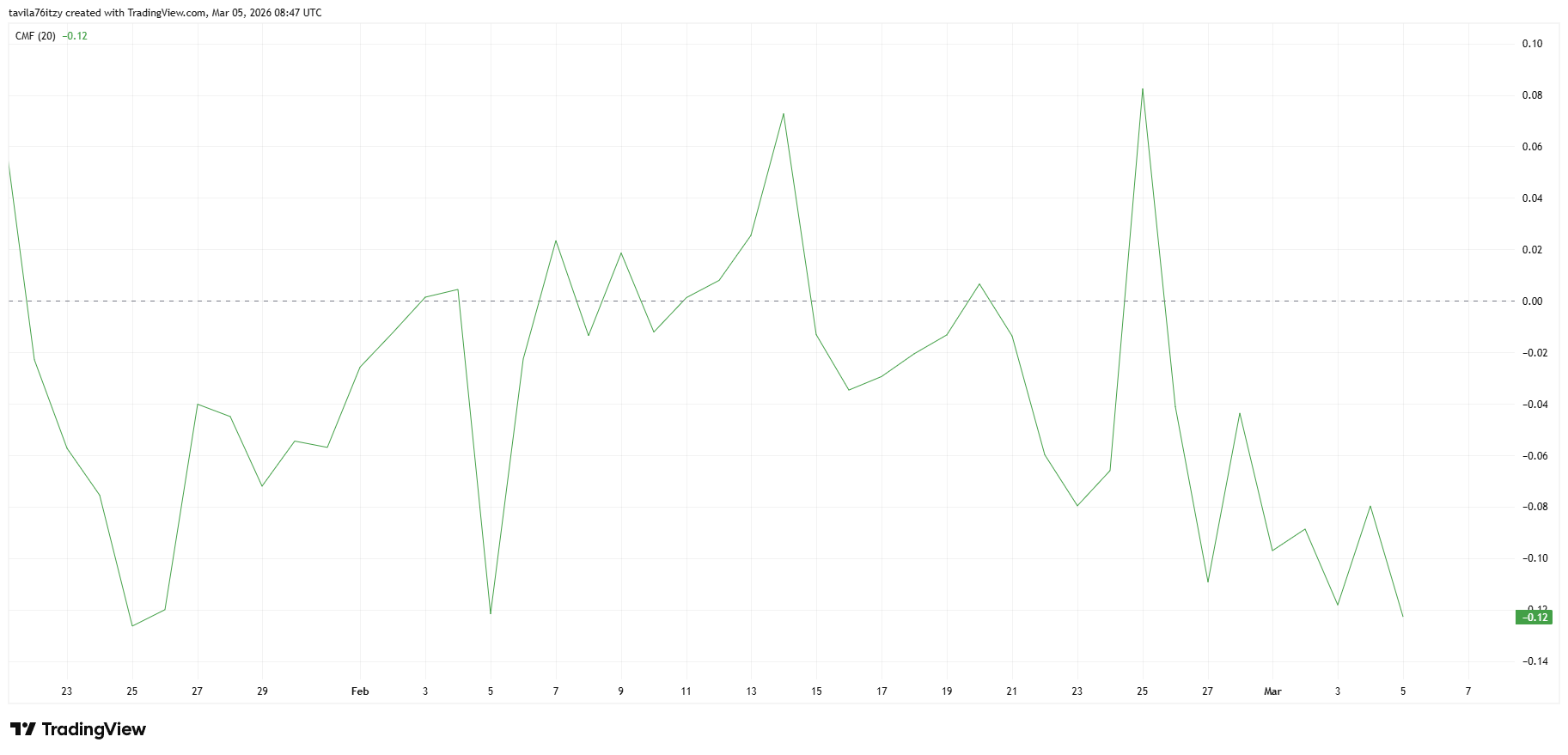
Dogecoin CMF – Source – TradingView
With CMF trending lower again, the near-term outlook leans bearish. If outflows persist, DOGE could continue drifting lower or consolidate, unless CMF recovers above zero to signal renewed accumulation.
Dogecoin Holders Turn Skeptical
The Exchange Net Position Change for Dogecoin reflects how much DOGE is moving into or out of cryptocurrency exchanges. The extended period of large negative net position changes (red bars) indicates significant and sustained outflows of DOGE from exchanges. When holders withdraw tokens from exchanges to private wallets, it is often interpreted as a sign of accumulation and long-term holding, since coins stored off exchanges are typically less likely to be sold immediately.
Throughout late January to mid-February, the outflows intensified, suggesting strong buy-side demand and confidence. During this phase, large amounts of DOGE were removed from exchanges, reducing the liquid supply available. This kind of supply contraction can help support price stability, as fewer coins are readily available to be sold on the market.
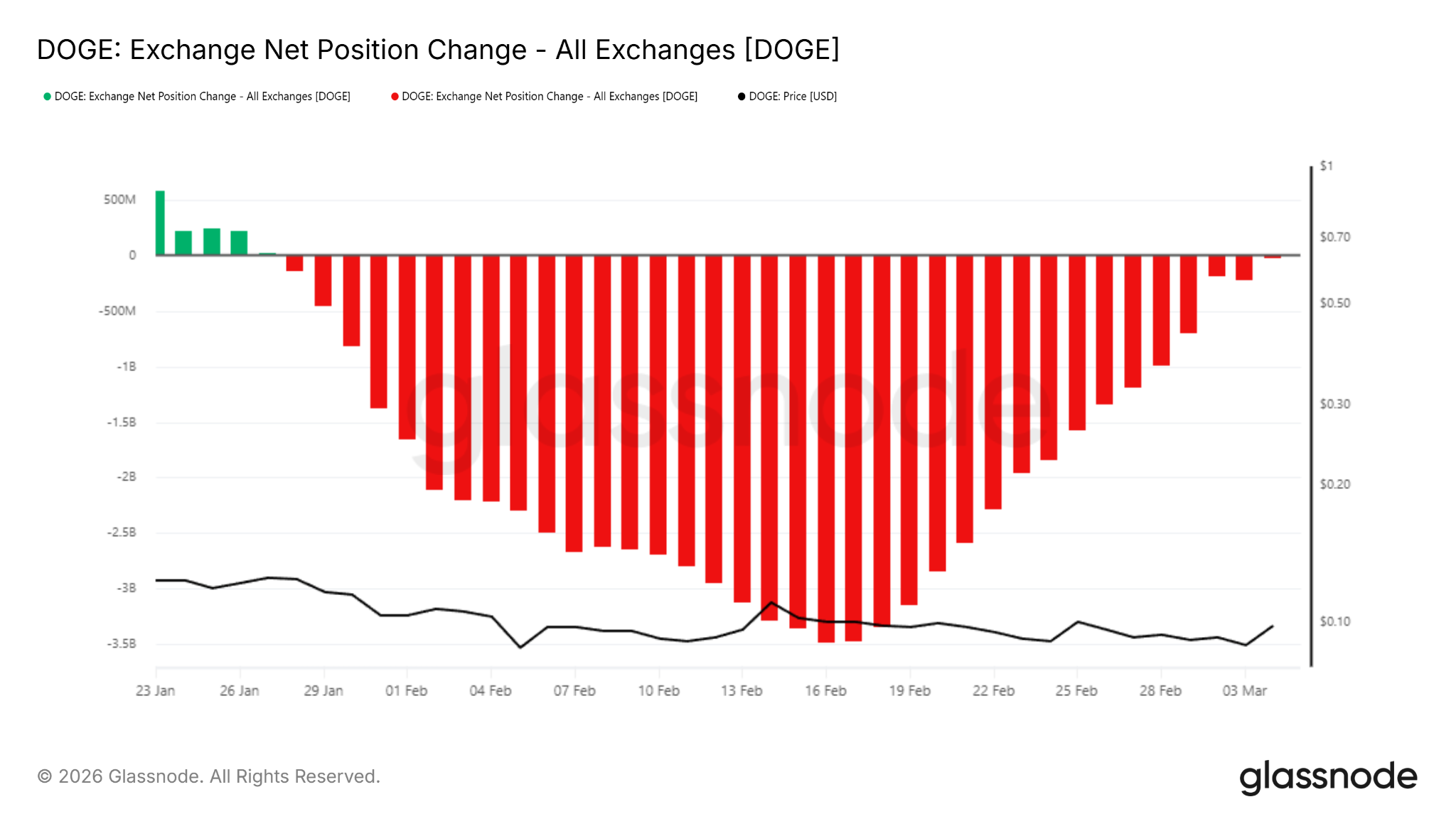 Dogecoin Exchange Net Position Change – Source – Glassnode
However, the more recent data show that these outflows are gradually decreasing in magnitude. While exchanges are still seeing net withdrawals, the pace of accumulation appears to be slowing. This shift may indicate that holders are becoming more cautious or that the strongest phase of accumulation has already passed.
If this trend continues and exchange balances begin to stabilize—or eventually rise—it could signal rising sell-side liquidity, potentially introducing downward pressure on DOGE’s price in the near term.
Some Dogecoin Holders Provide Relief
The HODLer net position change for Dogecoin indicates whether long-term holders are accumulating or distributing DOGE over time. Across most of the period, the inflows remain strongly positive, meaning long-term holders are consistently expanding their DOGE balances rather than selling. This behavior reduces the circulating supply available in the market, which can ease selling pressure and help stabilize price movements.
Notably, even during periods when the price dips, long-term holders continue accumulating. This suggests conviction among experienced holders, who often act counter-cyclically by holding or buying when market sentiment weakens.
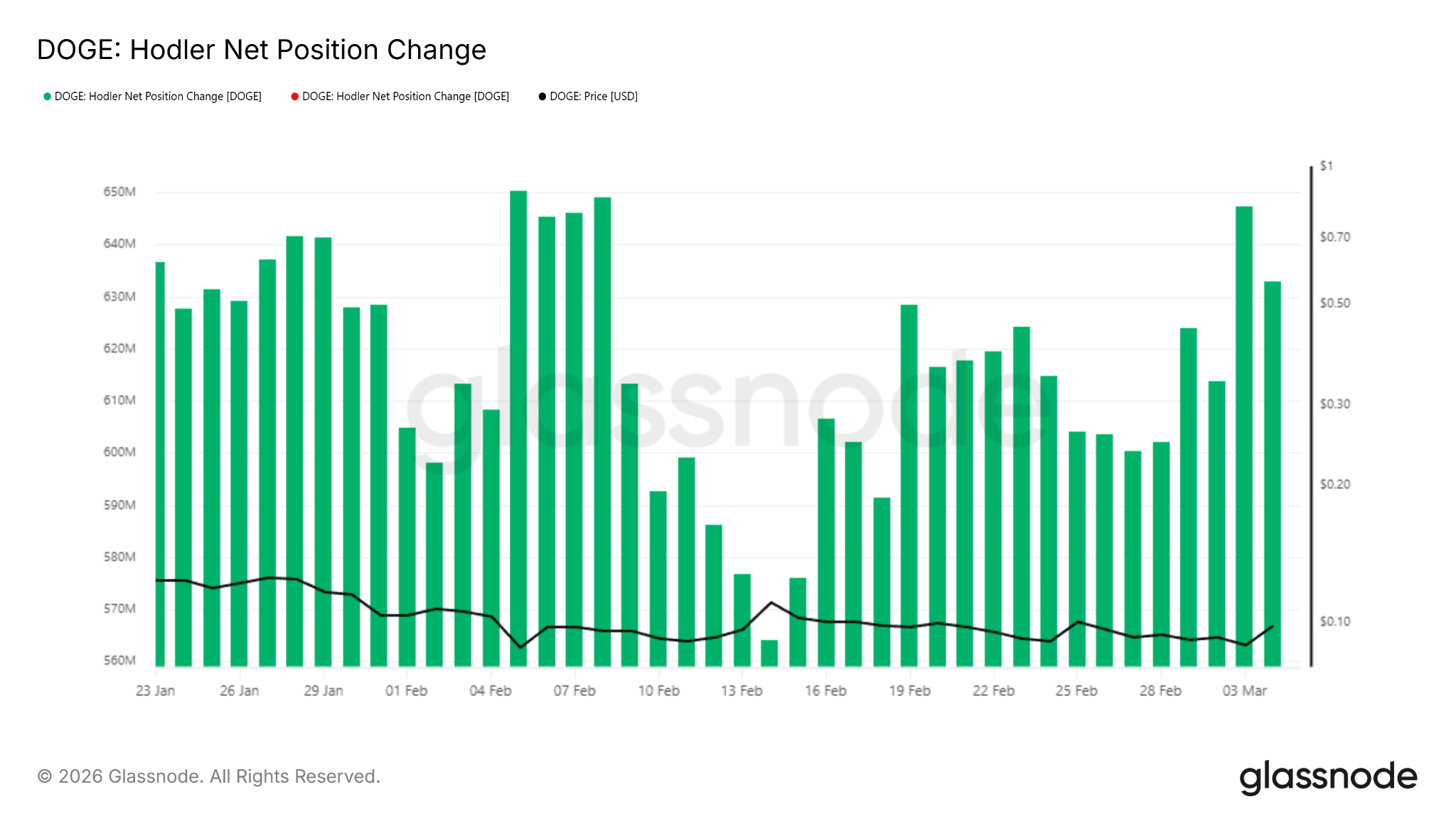
Dogecoin LTH Position Change – Source – Glassnode
The spikes in accumulation toward early March indicate renewed confidence, with large amounts of DOGE moving into long-term storage. Overall, the data implies that HODLers are providing price support by absorbing supply, helping cushion DOGE against sharper declines.
DOGE Price Faces Threat
DOGE price is changing hands near $0.09538, sitting just above the 0.382 Fibonacci level at $0.09436. The Fibonacci retracement drawn from $0.08001 to $0.12643 highlights weakening momentum after repeated rejections below 0.618 at $0.10322, confirming persistent short-term bearish pressure.
If $0.09436 fails to hold, downside liquidity is likely to target $0.08887 (0.236 Fibonacci) as the next structural support. A breakdown below this level exposes $0.08001, the swing low that previously triggered a strong reaction. Continued lower highs across recent candles indicate sellers remain dominant despite occasional bullish relief candles.
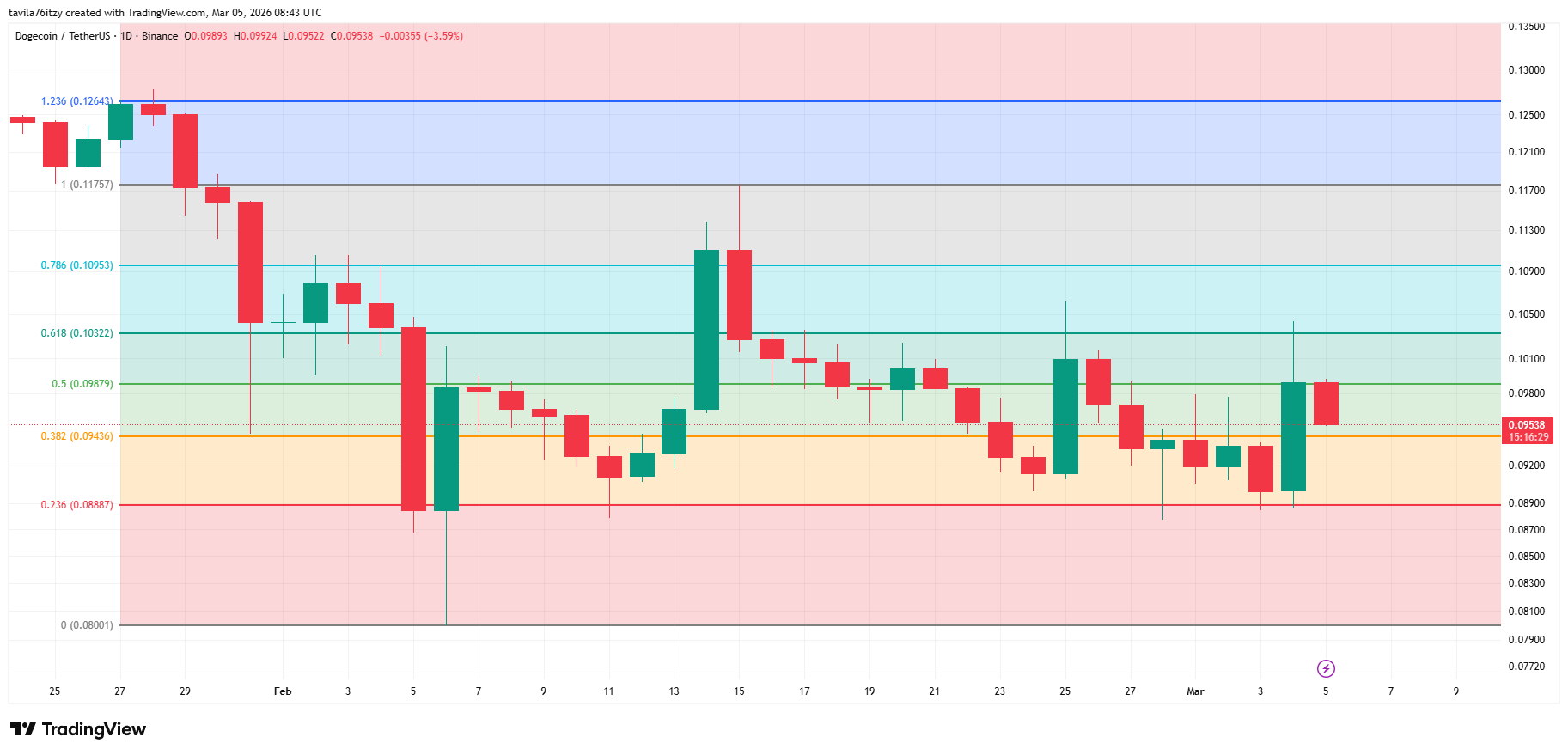
Dogecoin Price – Source – TradingView
For bullish continuation, DOGE must reclaim $0.09879 (0.5 Fibonacci) and flip it into support, opening a move toward $0.10322 (0.618) and $0.10953 (0.786). The bearish outlook becomes invalid with a decisive daily close above $0.11757, which would break the Fibonacci resistance cluster and shift momentum toward $0.12643.
Will Capital Outflows From Dogecoin Benefit New Tokens Like Minotaurus?
The recent momentum behind Dogecoin is drawing renewed attention to smaller-cap cryptocurrencies. One project that could benefit from this shift is Minotaurus (MTAUR), a blockchain gaming token focused on utility rather than hype.
While many meme coins rely primarily on community sentiment, MTAUR aims to build value through a functional ecosystem designed around real use cases. This approach may attract holders who prioritize projects with clear utility.
Entering smaller-cap tokens early often involves greater risk, but it can also present significant upside. In bullish market environments, these assets sometimes perform better compared to large-cap cryptocurrencies. Because of this dynamic, some holders are beginning to explore emerging tokens alongside their established holdings.
Minotaurus sets itself apart by integrating its token directly into gameplay. MTAUR acts as the primary in-game currency within a blockchain-powered maze adventure. Players spend the token to unlock new areas, activate upgrades, and access consumable items within the game environment.
This framework creates demand linked to player activity rather than pure speculation. Tokens with built-in utility like MTAUR can sometimes maintain relevance even during broader market pullbacks. Blockchain gaming remains one of the more active and developing sectors within the crypto space.
Careful risk assessment remains important when considering early-stage projects. To strengthen credibility, Minotaurus has completed independent smart contract audits conducted by SolidProof and Coinsult, both of which review project security and technical integrity.
The token runs on Binance Smart Chain, which enables faster and lower-cost transactions while supporting scalability. In terms of supply management, the project uses structured cliff and vesting mechanisms to prevent sudden token releases. Notably, only 2% of the total supply is allocated to the team.
At present, MTAUR changes hands at 0.00012684 USDT, a price level that could attract Dogecoin holders looking to diversify into emerging opportunities.
Disclaimer: This is a Press Release provided by a third party who is responsible for the content. Please conduct your own research before taking any action based on the content.
Get 3 Free Stock Ebooks
Discover top-performing stocks in AI, Crypto, and Technology with expert analysis.
- Top 10 AI Stocks - Leading AI companies
- Top 10 Crypto Stocks - Blockchain leaders
- Top 10 Tech Stocks - Tech giants