


TLDR
- UNI price surged approximately 15% over 24 hours, beating Bitcoin’s 4.7% and Ethereum’s 8.5% gains
- Governance proposal seeks to extend Uniswap’s fee switch mechanism to eight more blockchain networks
- Expansion projected to generate approximately $27 million in additional yearly revenue beyond current ~$34 million
- More than $5.5 million in UNI tokens have been burned since fee switch activation in late 2025
- First quarter 2026 gross profit reached approximately $3.12 million, up from zero in previous quarters
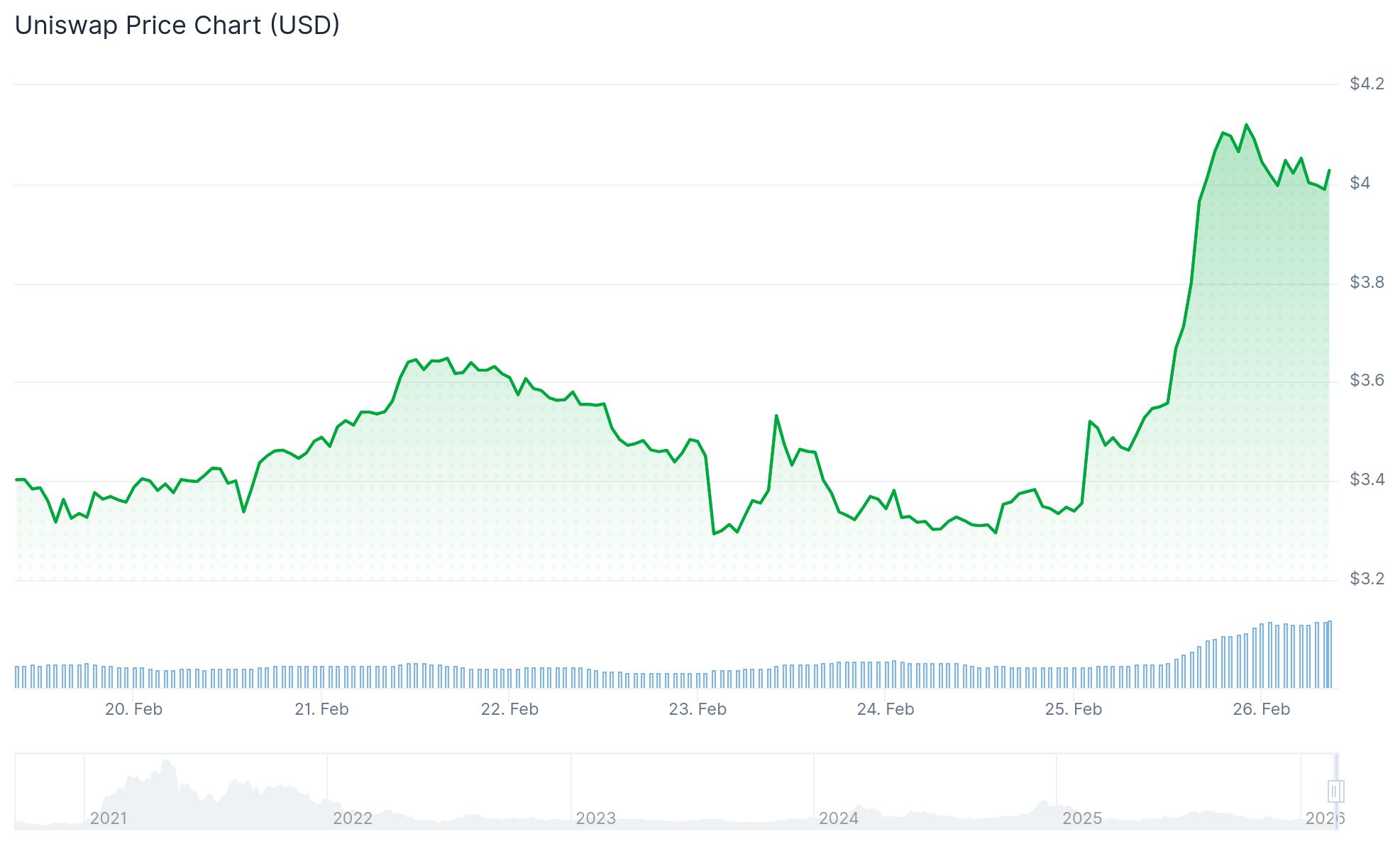
Uniswap’s native token UNI experienced a significant rally of approximately 15% within a 24-hour trading window on February 26, 2026, significantly outperforming the wider cryptocurrency market following news of a critical governance proposal affecting protocol revenue generation.
During the same timeframe, Bitcoin recorded gains of roughly 4.7%, while Ether posted approximately 8.5% increases. UNI’s performance stood out as among the strongest in the major token category.
The price movement was triggered by a governance proposal seeking to extend Uniswap’s fee switch functionality to eight additional blockchain ecosystems, encompassing various layer-2 scaling solutions.
The fee switch represents a revenue mechanism that diverts a portion of transaction fees from liquidity providers to the protocol’s treasury. These accumulated funds are subsequently deployed for UNI token buyback operations and burning activities.
The current proposal would transition from the existing pool-specific fee activation approach to a comprehensive tier-based v3 framework, implementing protocol fees across all liquidity pools automatically.

A newly developed utility called the v3OpenFeeAdapter would enable automatic fee collection for all newly created v3 pools, eliminating the requirement for individual governance approval for each pool.
Projections indicate the multi-chain expansion could produce approximately $27 million in incremental annualized revenue, supplementing the roughly $34 million currently being collected and allocated toward UNI token burns.
Fee Switch Already Burning Millions
Following the initial fee switch deployment in late 2025, Uniswap has successfully burned over $5.5 million in UNI tokens, suggesting an annualized burn rate approaching $34 million based on present trading activity.
During the first quarter of 2026, Uniswap generated roughly $3.12 million in gross profit based on DeFi Llama analytics, a dramatic increase from negligible profits in preceding periods.
The governance decision has been divided into two separate onchain voting procedures due to technical transaction size constraints.
Price Action and Technical Levels
UNI reached intraday peaks exceeding $4.00 throughout the trading session, accompanied by a roughly 62% surge in daily trading volume.
Notwithstanding the daily advance, UNI maintains negative performance across weekly, monthly, and year-to-date timeframes. The token continues trading beneath its 50-day, 100-day, and 200-day simple moving average indicators.
The daily Relative Strength Index registers approximately 56, suggesting additional upside capacity before entering overbought conditions. The MACD histogram displays emerging bullish momentum signals, with $3.20 recognized as a possible local floor.
Bollinger Bands position UNI above the upper band threshold at $3.81. A successful breach above the 50-day SMA would bring the 100-day SMA near $5.09 into consideration.
Critical support zones are established at $3.48 and $3.00 on potential downside movements.
BlackRock recently acquired UNI tokens as component of a strategic initiative to leverage Uniswap for facilitating transactions involving its BUIDL tokenized Treasury product.
Open interest in UNI futures is expanding while funding rates maintain positive territory, according to Coinglass market data.
Get 3 Free Stock Ebooks
Discover top-performing stocks in AI, Crypto, and Technology with expert analysis.
- Top 10 AI Stocks - Leading AI companies
- Top 10 Crypto Stocks - Blockchain leaders
- Top 10 Tech Stocks - Tech giants



