



TLDR
- Supreme Court’s rejection of emergency tariff authority prompted Trump to implement 15% global tariffs under alternative legislation
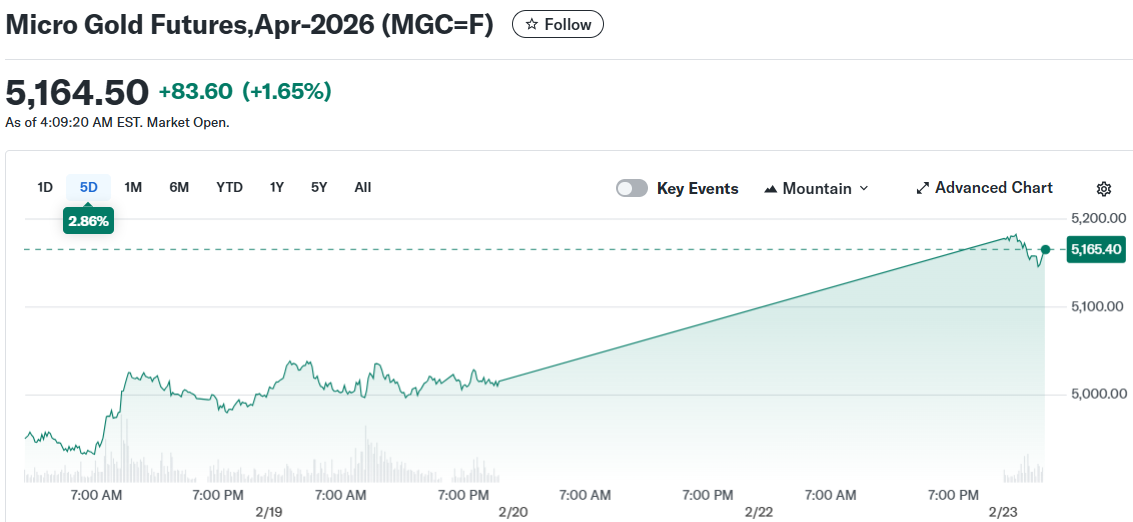
- Gold extended its winning streak to four consecutive sessions, reaching $5,170 in U.S. futures trading
- International trade agreements with EU, India, and Japan face significant delays and uncertainty
- Weakening U.S. economic growth combined with persistent inflation drives safe-haven buying
- Silver surged 2.3% to $86.56/oz; hedge fund positioning in gold reaches near-yearly lows
Precious metals continued their upward trajectory on Monday as President Trump unveiled a sweeping 15% global tariff, triggering market volatility and amplifying demand for traditional safe-haven investments.
U.S. Gold Futures advanced 1.8% to reach $5,170.19. Spot gold prices increased 0.8% to $5,148.66 per ounce during Monday morning trading sessions.
This development came after the Supreme Court invalidated Trump’s attempt to leverage emergency powers for implementing import duties. Trump responded by invoking Section 122 of U.S. trade legislation, initially implementing a 10% tariff before escalating it to 15% — the maximum threshold permitted under that legal provision.
International Trade Agreements Face Uncertainty
The Supreme Court’s decision has cast doubt over multiple international trade negotiations. The European Union’s trade representative indicated plans to recommend postponing ratification of a U.S. agreement pending greater policy transparency.
Indian government representatives canceled a scheduled delegation visit to America. A Japanese ruling party official characterized the circumstances as “a real mess.”

This ambiguity prompted investors to retreat from risk-oriented assets. Capital flowed into gold and U.S. Treasury securities as market participants awaited additional information regarding tariff implementation, timeline, and possible legal contestation.
A declining dollar provided additional momentum to gold’s ascent. The Bloomberg Dollar Spot Index decreased 0.2% Monday, matching Friday’s decline. Dollar weakness enhances gold’s appeal for international currency holders.
Economic Slowdown and Inflation Pressures Bolster Gold
Recent U.S. economic indicators released last week reinforced the rationale for maintaining gold exposure. Fourth-quarter GDP expanded at merely 1.4% on an annualized basis, marking a substantial deceleration from the previous quarter.
Simultaneously, the Federal Reserve’s primary inflation gauge — the PCE index — indicated prices climbing 2.9% year-over-year in December. The core measurement registered approximately 3.0%, continuing to exceed the Fed’s 2% inflation objective.
The convergence of decelerating economic expansion with persistent inflation represents a historically favorable environment for gold as both a wealth preservation vehicle and economic uncertainty hedge.
Escalating geopolitical tensions between the United States and Iran maintained buyer interest. While negotiations regarding Iran’s nuclear capabilities proceed, substantial U.S. military deployments in the region sustain cautious market sentiment.
Other Metals
Silver jumped 2.3% to $86.56 per ounce. Platinum edged up 0.3% to $2,164.60/oz. Copper futures remained relatively unchanged.
Commodity Futures Trading Commission data reveals hedge fund net-long positions in gold futures have declined to their lowest point in approximately twelve months, indicating potential capacity for additional buying momentum.
Spot gold was last quoted at $5,134.16 as of Monday afternoon in Singapore, with market analysts cautioning that near-term price fluctuations are probable as U.S. trade policy continues evolving.
Get 3 Free Stock Ebooks
Discover top-performing stocks in AI, Crypto, and Technology with expert analysis.
- Top 10 AI Stocks - Leading AI companies
- Top 10 Crypto Stocks - Blockchain leaders
- Top 10 Tech Stocks - Tech giants



